
REVIEW · FREEDOM TRAIL WALKING TOURS
Boston’s Freedom Trail: A Self-Guided Tour of All 16 Sites
Boston history, but on your schedule. This self-guided Freedom Trail audio walk takes you to all 16 sites with spoken directions and stories timed to where you stand. It is a smart fit if you like facts without the pressure of keeping up.
Two things I really like. First, the offline access means you can keep going even if cell service is spotty in older parts of Boston. Second, the narration style is clear and easy to follow, with a light, funny tone that makes the stories stick (including the Boston Tea Party, the Boston Massacre, and Paul Revere’s Midnight Ride).
One possible drawback: the app experience depends on your phone. A few people found the download setup a bit confusing, and in at least one case the map/audio needed some manual nudging when it did not jump forward perfectly.
Key things to know before you go
- Audio starts as you reach each stop, so you are not constantly checking your phone for what to do next
- Offline maps and geodata help you keep moving through central Boston without relying on signal
- 16 Freedom Trail sites in one continuous route, from major meeting places to burial grounds
- Directions are built into the experience, which is a big win if you do not want a live group tour
- Plenty of chances to pause for food, since the route passes high-energy spots like the historic marketplace area
Other ways to walk the red brick, compared
Freedom Trail, minus the herd: what makes this audio tour work
This is Freedom Trail sightseeing designed for real life. You choose the pace. You stop for photos when the light is right. You wait out a crowd. And you do not have to plan your day around a group’s walking speed.
The audio tour runs through the full set of 16 Freedom Trail sites, and it is built around the moment you arrive. That matters, because the Freedom Trail is a chain of “small distances, big stories.” If you are moving too fast, those stories smear together. With timed audio, you can keep each moment separate.
The narration leans into storytelling, not dry bullet points. You get the big events, but also the human scale: town meetings and public spaces, the tension between colonists and British power, and the way Boston’s leaders and ordinary residents were part of the same streets you are walking today.
If you like doing things solo, this format is especially comfortable. The experience is private to your group, so you are not sharing audio with strangers or dealing with the “which number are we on” chaos you sometimes get with guided tours.
Price and value: is $14.99 worth it?
At $14.99 per person, you are paying for a lot more than audio files. Your ticket includes lifetime access to the tour in English, plus offline access to audio, maps, and geodata.
Here is how I think about value:
- You get a full walking itinerary without paying for a guide and without buying museum tickets along the way.
- You can replay sections later if something catches your interest, or if you missed a detail because you were stuck answering a question from a stranger in your path.
- Offline support is practical in Boston, where older streets and buildings can make signal unreliable.
It is not a “one and done” purchase. Lifetime access means you can return, re-walk a portion, or use it to stitch together your own mini itinerary when you come back to Boston another time.
The route in order: your walk from Faneuil Hall to Copp’s Hill Terrace
You start at 139 Tremont St and finish at Copp’s Hill Terrace, 520 Commercial St. Plan for an easy-to-moderate walk that still takes focus, because the narration cues you by location.
Below is what you will experience at the major stops spelled out in the tour details.
Faneuil Hall: from town meeting hall to government auditorium
You begin with Faneuil Hall, once a place where Samuel Adams used to speak. Today it is a government auditorium, and the tour frames it as a reminder that Boston politics was never just scribbles and proclamations. It was public, loud, and tied to real people.
The practical benefit here is you get your “how to read Boston” lesson early. The tour helps you notice why these buildings matter, not only what happened in them.
More routes you can walk at your own pace


The core Freedom Trail stories: Tea Party, Midnight Ride, and Boston Massacre context
As you continue, the audio sets up the big turning points you will meet along the way. You get guided context for three anchor ideas:
- the Boston Tea Party as a planned act of resistance, including the famous act of tossing tea into Boston Harbor
- Paul Revere’s Midnight Ride, including the fact that it comes before his later arrest
- the Boston Massacre, described as an incident where unarmed citizens were shot dead in a confrontation with British soldiers (the tour also notes the “nine officers versus a crowd” setup and the loss of five Boston lives)
This is valuable because it keeps the later stops from feeling like random plaques. You learn the “why” before you hit the “where.”
Brewer Fountain and the Massachusetts State House: how Boston got built
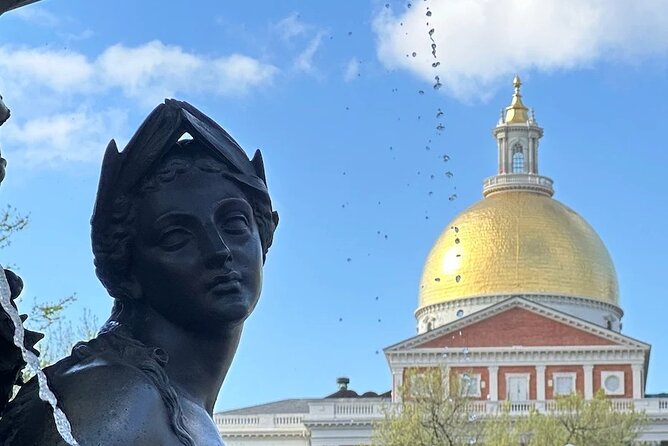
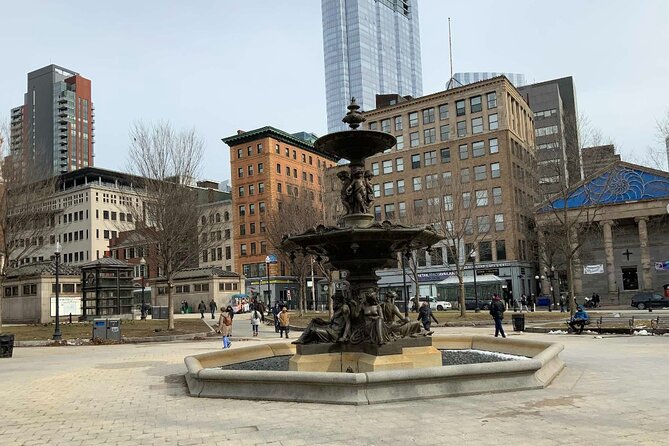
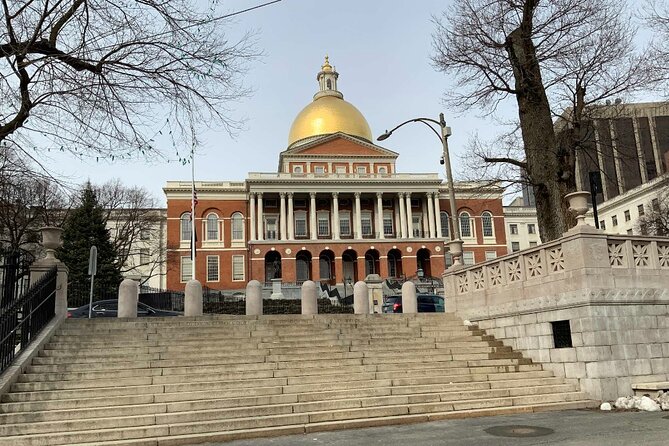
Next you hit Brewer Fountain, with a story about how Boston was formed. Then you take in the Massachusetts State House, described as an impressive gold-and-brick structure.
Even if you have walked past a government building before, this kind of narration changes what you see. The State House stops being just an impressive facade and becomes a symbol of power shifting, laws forming, and leaders arguing their case in the open.
Copp’s Hill graveyard: famous Bostonians in dusty company
Then you move to Copp’s Hill and its graveyard. The tone here is quieter and more personal. You are not just learning dates. You are standing where well-known figures of Boston’s past were laid to rest.
The tour calls out notable names you will recognize from American founding history, including James Otis, John Hancock, Paul Revere, and Samuel Adams.
This stop is also a great example of why self-guided audio works. You can slow down, look at names, and let the stories land without feeling like you are holding up anyone else.
The Old State House (dating to 1713): Boston’s trading position
One of the oldest buildings on the route dates back to 1713 and is tied to Boston’s unique trading position. This is where the tour helps you connect economics to politics.
A lot of American history lessons focus on speeches and battles. This adds a key ingredient: trade. You start to see how Boston’s wealth, commerce, and shipping made it a target and a stage for conflict.
Old City Hall: the legal system gets a birthplace story
You also get a stop at the Old City Hall, described as having a grand facade and tied to the birth of the American legal system.
This is one of those moments that can sound abstract if you read it on a sign. Hearing the legal system framed as something born from real events and real institutions makes it easier to understand why this era mattered beyond the battlefield.
Old South Meeting House: planning the Boston Tea Party
Old South Meeting House is presented as the largest building in colonial Boston at one point, and it is also where the Boston Tea Party was planned.
This stop hits hard because meetinghouses were not just “where people gathered.” They were the communication hubs and organizing rooms of the time. The tour’s framing makes you think about strategy and coordination, not only rebellion.
The Massachusetts State House revisited: reflecting on revolution
You spend time again with the Massachusetts State House in the flow of the narration. This repetition is not a mistake if you think of it as a learning loop.
It is a chance to revisit what you saw earlier and connect it to the American Revolution theme the tour highlights. Sometimes the best learning happens when you return to the same big visual after you have picked up more context.
Beantown Pub pause: a realistic break without breaking the walk
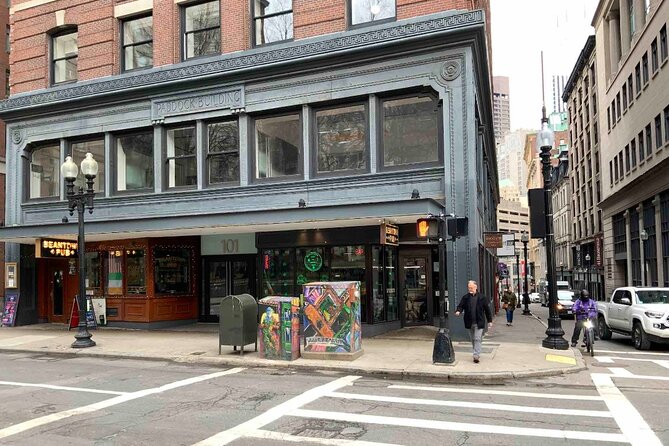
You are given a stop to grab a refreshment at Beantown Pub, described as a Boston favorite and home of Sam Adam’s beer.
This is not just a suggestion for a drink. It is a practical design choice. The route gives you a “pause valve” so you can reset without having to abandon the walking plan.
If you want a food break, you are in the right part of town for it.
Irish immigrant history: migration shaped by biological tragedy
The tour also includes a stop focused on Irish immigrants in America and the biological tragedy that forced them to leave their homeland.
This part of the experience matters because it widens the story beyond colonial politics. Boston’s founding-era drama is only one layer of why the city looks and sounds the way it does.
Boston Massacre site: 1770, nine officers, and the cost
You get the Boston Massacre location described as an incident in 1770 where nine British officers faced a crowd of hundreds. The tour notes that five Boston lives were lost during the revolt.
This is a stop you should treat with respect and a little space. Standing in the place where a confrontation turned deadly is not something you want to rush through. Let the audio slow your pace down a notch.
Boston’s oldest outdoor market: deals and the city’s food pulse
Finally, you explore Boston’s oldest outdoor market, described as offering deals on fresh produce, fish, and flowers in the historic heart of the city.
This is a smart way to end the story loop. You finish with daily life, not only revolution narratives. Even if you do not plan to shop much, seeing the market area helps you remember that Boston did not become historic and then freeze. It kept moving.
And you still end your walk at Copp’s Hill Terrace, which gives you a strong finale after the political and memorial stops.
How the VoiceMap app works when you want it to, not when you wish it would
You use the VoiceMap app on Android or iOS. The tour includes offline access to audio, maps, and geodata, which is the biggest practical advantage.
Here is how to make it smooth:
- Download before you start walking, so you do not burn battery while the route is already in motion.
- Bring headphones since smartphone and headphones are not included.
- Expect a phone in your hand at the beginning, even if later the experience starts automatically.
One thing to keep in mind from user experiences: the experience is generally easy to follow, but a few people reported that the app was slightly confusing to start and that they sometimes had to manually move forward. If that happens to you, it is not a failure, it is just tech being tech. You can still keep going at your pace.
How long it takes, and how to pace the day
The duration listed is 2 hours to 2 hours 40 minutes. Some people reported it takes about 2.5 hours to see everything comfortably.
For pacing, I suggest:
- Start when you have time to spare. Rushing is when audio tours become “walk and regret.”
- Build in short pauses at major sites, especially Copp’s Hill and the Boston Massacre stop, where you might want extra reading time.
- Take breaks for food if you want them. The route already includes a refreshment stop, and the market area makes it easy to end with something real.
If you are traveling with someone and you both want audio, this setup works well because each person can listen on their own device. One couple also used the map feature to keep timing aligned with the narration.
Who this fits best, and who might want something else
This tour is ideal if you:
- want a self-guided way to cover all 16 sites without joining a group
- like humor and story voice in your historical walking
- travel solo, as it gives you freedom and a clear route
- enjoy the option to pause and continue without stress
It might be less ideal if you:
- hate doing app setup or troubleshooting on your vacation day
- rely on map GPS only and do not want any chance of manual audio control
Also, because it is self-guided, you are responsible for your footing and timing. You are not paying for real-time correction from a human guide.
That said, the route is described as clear, and the audio plus map design is meant to prevent getting lost.
Should you book this self-guided Freedom Trail audio tour?
Yes, I think you should book it if you want Freedom Trail coverage with flexibility, and you value offline audio and maps. The price is low enough that it feels like a practical decision, not a big gamble. And the format is a strong match for both solo walks and couples who want to talk as they move.
I would hesitate only if you know you will be frustrated by app setup and tiny tech glitches. If that sounds like you, consider a live guide instead.
If you are okay bringing headphones and downloading ahead, this is a great way to experience Boston’s founding-era landmarks on your terms, with stories you can replay whenever you want the next walk to hit a little deeper.
FAQ
How much does the Boston Freedom Trail self-guided audio tour cost?
The price is $14.99 per person.
How long does the tour take?
It takes about 2 hours to 2 hours 40 minutes.
Does the tour cover all 16 Freedom Trail sites?
Yes, the audio tour takes you to all 16 sites.
What language is the tour available in?
The tour is offered in English.
What do I get with the purchase?
You get lifetime access to the tour in English, plus offline access to audio, maps, and geodata, through the VoiceMap app.
Do I need a smartphone and headphones?
A smartphone and headphones are not included, so you will need your own.
Where does the tour start and end?
It starts at 139 Tremont St, Boston, MA 02111, and ends at Copp’s Hill Terrace, 520 Commercial St, Boston, MA 02109.
Is transportation included?
No. Transportation is not included.
Is the tour offered as a private experience?
Yes. It is private, and only your group will participate.
Is this tour refundable if I cancel?
The experience is non-refundable and cannot be changed for any reason.
Keep Going in Boston





More Routes at Your Own Pace




The Red Line, Three More Ways



More around Boston, freshly written up
- The Boston Bash Scavenger Hunt★ 4.5 · 3 reviews
- Self-Guided Audio Tour of Boston North End★ 4.5 · 3 reviews
- Self-Guided Boston Christmas Tour★ 5.0 · 3 reviews
- Self Guided “The North End Pizza, Cannoli and Picnic” Solo Walking Tour★ 5.0 · 3 reviews
- Cambridge: Haunted Charles River Cruise★ 4.3 · 3 reviews
- Boston: Official Freedom Trail® Lantern Tour★ 4.7 · 3 reviews
Freedom Trail Walking Tours, compared.
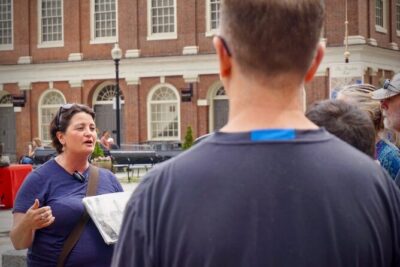 ★ 5.0Freedom Trail History Small Group Walking TourFrom $356,450 reviews
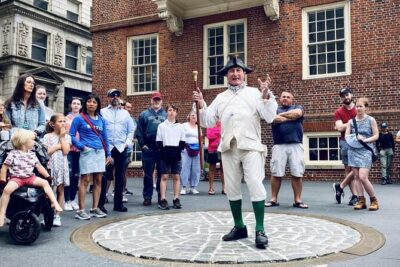 ★ 4.5Boston Freedom Trail Walking Tour with Costumed GuideFrom $262,531 reviews
 ★ 5.0Boston Food & History: Pizza, North End & Freedom TrailFrom $901,772 reviews
 ★ 4.9Boston’s Freedom Trail: A Revolutionary Walking TourFrom $311,748 reviews
★ 4.9Freedom Trail History Small Group Walking TourFrom $351,590 reviews
★ 5.0Boston’s Freedom Trail: A Revolutionary Walking TourFrom $311,343 reviews
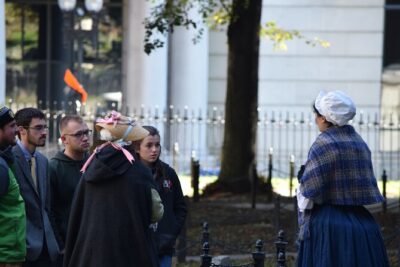 ★ 4.5Freedom Trail Walking Tour 250From $261,118 reviews
 ★ 5.0Boston Freedom Trail History Pub Crawl Small-Group TourFrom $60996 reviews