

REVIEW · FREEDOM TRAIL WALKING TOURS
Boston Freedom Trail Self-Guided Tour with Audio Narration & Map
The Freedom Trail, now on your schedule. This self-guided Boston walk uses GPS cues and audio narration, so you can start when you want, pause for a photo or snack, and then keep going along the red-brick route from downtown through the North End to Charlestown.
I love the hands-free GPS audio that automatically triggers the next story as you reach each highlight. I also love the offline map and lifetime access, so you can use it again on a future trip without paying twice.
One thing to plan for: the walk and timing. Even though people often describe the Freedom Trail as around 2.5 miles, this audio route can run about 3 to 4 hours (and roughly 3+ miles), and the tour can end in a different place than where you started, so you may want a return plan, especially if you drive.
Key highlights at a glance
- $9.99 price for a long walk with 51+ audio stories
- Offline maps and location-based audio (download once on strong Wi-Fi)
- Go at your own pace, start, stop, and replay stories whenever you like
- Route covers the classic stops, from Boston Common to USS Constitution and Bunker Hill
- Practical app experience with an easy-to-follow map and on-screen prompts
Other ways to walk the red brick, compared
A $9.99 GPS walk along the Boston Freedom Trail

For under ten bucks, you get a serious chunk of Boston history you can experience on your schedule. The route follows the Freedom Trail markers through key Revolutionary-era landmarks, mixing big “you’ll recognize this” stops with smaller sites that are easy to miss if you are just wandering.
The value here is not just the low price. It is the format. You get a self-guided route that is still structured, with GPS-based audio that keeps you moving from one point to the next. That means less time checking your phone, and more time actually walking the streets that shaped the story.
You can also treat this like a choose-your-own-adventure. Want only the Revolutionary War scenes? Great. Want extra detail at a cemetery or church? You can focus there. This kind of flexibility is ideal when you are traveling with different interests, or when you want to avoid the “hurry along” feeling of group tours.
The Action Tour Guide App: offline map and auto audio cues
This is built around an app, and the app is the whole point. After booking, you get email and text instructions with a password. Then you download the separate Action audio tour guide app, enter the password, and you are set up for offline use.
Two practical things matter most:
1) Download before you start. The instructions say you must download the tour while on strong Wi-Fi or cellular. After that, it works offline.
2) Expect audio tied to your location. The narration is meant to start automatically at the next story point, based on GPS. In plain terms, you are not reading a script. You are walking while the guide talks, and you get prompted to move on as you reach each highlight.
If you rely on your phone for navigation anyway, this is painless. If you hate holding a phone out, bring earbuds and keep your screen tucked away. Also, plan for battery life. Several users found the format smooth once the setup was right, but when the app did not behave, it tended to come down to audio or GPS behavior.
Route reality check: how far, how long, and where it ends
The itinerary is often described as a 2.5-mile Freedom Trail walk, but the complete audio experience is longer in practice. The route is about 3 miles with more than 51 audio stories, and the typical finish time is around 3 to 4 hours.
Here is what that means for you:
- If you move steadily and only pause briefly, you can finish within that 3 to 4 hour range.
- If you linger at buildings, read signs, or stop for snacks, it can stretch longer. One reviewer noted it took about 6 hours when they went into some places.
- Parking can be tricky. The area around the start gets full quickly, so arrival timing matters if you drive.
Also, the tour ends in a different location. So if you are parking near your intended start point, you may face a longer walk back than you expect.
A smart workaround if you want to avoid a long return: use the subway. One practical tip shared was taking the Orange Line from Community College Station near Bunker Hill to Park Street Station by Boston Common. That is a logical way to get back toward the start area without backtracking.
Stop-by-stop: Boston Common, the State House, and the Revolutionary mood

Your walk starts in the heart of early Boston, where the city’s “before America” story really starts to feel tangible. The tour moves along the Freedom Trail markers that are easy to spot on the ground, and it uses the red-brick path as a kind of storyline spine.
More routes you can walk at your own pace
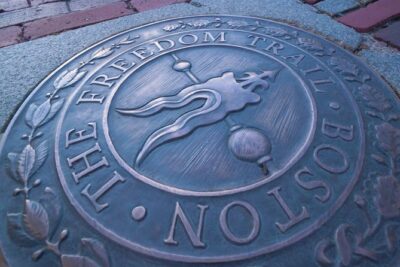


Freedom Trail overview, then Boston Common
Right away, you get oriented with a walk that threads together downtown Boston, the North End, and Charlestown. You pass classic landmarks like Faneuil Hall, the Paul Revere House, and USS Constitution, then you finish at the Bunker Hill Monument area.
From there, Boston Common is your first major green-space anchor. You start near the Visitor Center area and then follow the trail path. This stop sets the stage in the 1700s, giving you context for why people in Boston were thinking about revolution in the first place.
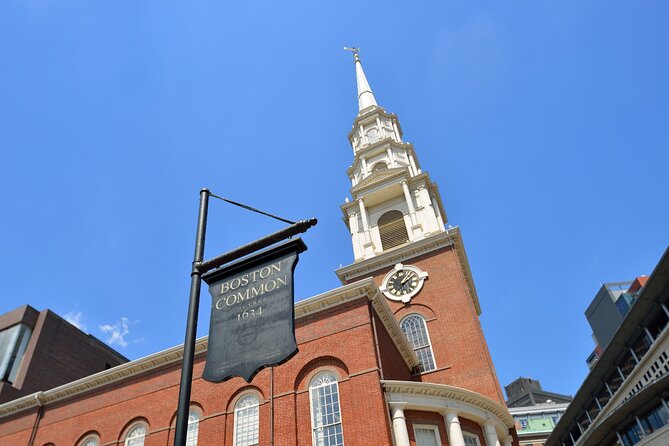
Massachusetts State House and Park Street Church
At the Massachusetts State House, you get the golden dome in your view and the Revolutionary cast of characters in the narration. One of the most useful benefits of audio here is pacing. You can stand in front of the building, listen for a few minutes, then look around at the details your eyes would otherwise miss.
Then you move to Park Street Church. This is where the tour turns from setting up the mood to explaining the deeper cause-and-effect of conflict. You get a bigger picture of what pushed the colonies toward war, presented as part of a longer chain of events instead of isolated “gotcha” moments.
Granary Burying Ground: Paul Revere, John Hancock, and Mother Goose
If you want a stop that rewards your curiosity, Granary Burying Ground is it. Founded in 1660, it gives you that time-warp feeling. You hear about prominent Revolutionary figures, including Paul Revere, Robert Paine, James Otis, John Hancock, and Sam Adams.
Then there is the quirky detail that makes the site feel alive: the grave of Mother Goose. The tour also points you toward the story of people killed in the Boston Massacre, teeing you up for that event at the later stop.
One caution: cemeteries can be emotionally heavy, even when you enjoy the history. Pace yourself here, and if you are walking in summer heat, bring water.
Boston Tea Party to the Boston Massacre site: the trail’s sharp edges

As you continue, the narration becomes more event-driven. You start moving through the places where rumor, protest, and politics collided in real time.
Boston Irish Famine Memorial and Old South Meeting House
Near the Irish Famine Memorial, you step forward in time and also widen the lens to immigration after the revolution. This stop helps balance the Revolutionary “founding” focus with the reality that many Bostonians were building new lives, not just debating independence.
Right across the street, you reach the Old South Meeting House. This is a big one for anyone who loves the Boston Tea Party story. The tour pauses in front and covers who organized the protest, what motivated them, and what happened next. You get the why, not just the spectacle.
Old State House: where architecture meets politics
Next is the Old State House. The narration emphasizes how to notice the building itself, then connects those visible features to the building’s significance and longer story in Boston. If you like history that you can “see,” this is a good stop to slow down for a few minutes.
Boston Massacre site: Crispus Attucks and the question behind the name
At the Boston Massacre site, the tour tackles the tricky phrasing. It asks whether it was truly a massacre, or more accurately a riot, pointing out that the British called it something else.
You also learn about Crispus Attucks, highlighted as an honored American figure. Standing at the actual spot is what makes audio narration work well here. You are not just hearing a date. You are hearing it next to the urban setting that witnessed it.
Faneuil Hall, Haymarket, and the North End arc
This stretch feels like the Freedom Trail in its most “Boston” form. The places are known, the streets are active, and the audio helps you look past the souvenir version of history.
Faneuil Hall Marketplace: history first, food second
At Faneuil Hall Marketplace, the narration covers the history of the site, then gives you permission to enjoy the reality of the location today. Since the tour is self-guided and designed for pauses, this is a great point to grab lunch or a snack.
One of the practical advantages reported by users is that you can stop for food, then pick the audio up later without losing your place. That makes this section less stressful.
Haymarket and nearby landmarks
Moving along, you reach Haymarket. The narration covers the area’s historic story, then connects it to modern landmarks you can see nearby, including the Holocaust Memorial and the view of the Custom House Tower beyond.
This stop is useful because it reminds you that “history stops here” is not true. Boston keeps layering eras on top of each other.
Paul Revere House and Old North Church: the lantern story
Next up is the Paul Revere House, focused on his famous Midnight Ride, and also the difference between the poem version and what is historically true. That myth-versus-fact angle is exactly the sort of detail that makes audio worth it.
Then you continue to the Old North Church, where the narration explains the lantern signal. You hear the classic line as one if by land, two if by sea. Even if you already know it, the stop tends to make it feel more grounded.
Copp’s Hill Burying Ground
From there you reach Copp’s Hill Burying Ground. It is an important emotional and visual stop because it is older than Granary Burying Ground by just a year. You also get time to appreciate how Boston’s cemeteries sit right next to the living city.
This stop is ideal for slowing down, especially if you are the kind of traveler who likes to read names and let places sink in.
Charlestown finale: USS Constitution and Bunker Hill Monument

The last segment gives you the big action moments. Once you cross into Charlestown Navy Yard territory, the tour moves from streets and civic buildings to a more military-focused chapter.
USS Constitution: the battle against the Guerriere
You end up at USS Constitution, where the narration covers the ship and her epic battle against the Guerriere. This is a strong capstone for anyone who wants the Revolutionary story beyond speeches and protests.
If you have limited time, this is a stop worth giving extra attention to. The audio here can help you understand why the ship’s fame lasts.
Bunker Hill Monument: intensity in audio and in place
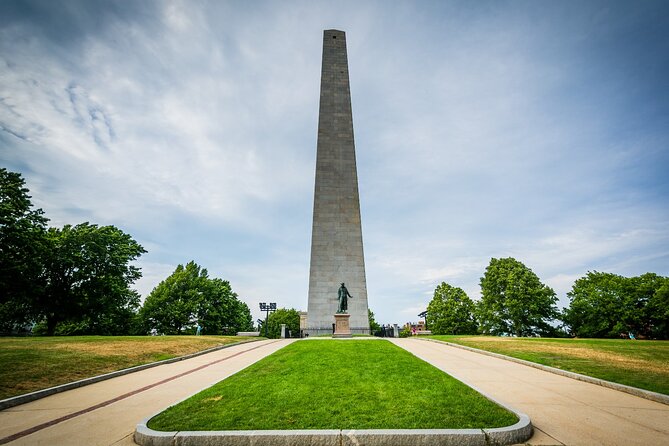
Finally, the route climbs up to the Bunker Hill Monument area. The tour is designed to let you walk around the hill and understand the brutality and intensity of the battle for freedom.
This is also where you should be honest with your energy level. If it is hot, if you are tired from earlier stops, or if you already stretched the walking time, you may want to keep your pace reasonable here. The audio helps, but it cannot replace rest.
How this tour compares to guided tours (and why that matters)

Guided tours can be great, but they come with friction: you hear the guide when the group stays put, and you miss details when you cannot stop. This format flips that.
Here is what you gain:
- You can listen and then look around at your own speed.
- You can repeat a story without asking the guide to back up.
- You can skip a stop if you are not feeling it that day.
- You can avoid crowds and noise by taking breaks when you want.
A couple of reviewers explicitly called out that the audio format was easier than trying to hear a guide in a group setting, and that it helped them learn more while moving at a comfortable rhythm. That is the biggest practical win for self-guided history.
Practical tips that make the experience smoother
A few small choices can make your walk much less stressful.
- Download the tour on strong Wi-Fi first. The setup instructions specifically say you must download the tour where the connection is strong.
- Bring earbuds or headphones. The tour audio is meant to be on your device, and support answers have suggested headphones and a power bank may be necessary.
- Start early if driving. Parking fills quickly in the area, and it can waste time if you are still searching when you want to begin.
- Expect traffic on peak days. One review mentioned heavy foot and motor traffic on a Saturday, which can slow your pace even when the audio is working correctly.
- If GPS misbehaves, don’t panic. Some users reported needing manual adjustment to keep audio aligned with the right story points. Keep the map open and move slowly through each landmark area until you hear the right prompt.
Who should book this Freedom Trail audio tour?
This is a great fit if you:
- Want a budget-friendly Freedom Trail experience that still covers the major sites.
- Prefer to learn without a group schedule.
- Like flexible pacing, especially if you want lunch breaks or photo stops.
- Are comfortable using a phone for audio and navigation cues.
It can be a weaker fit if you:
- Hate apps and would rather have a simple paper map and reading.
- Have audio processing or hearing challenges and are sensitive to small sound glitches.
- Need perfect GPS triggering and cannot tolerate needing to adjust occasionally.
That said, the average rating is strong, and the common theme is that once the app is set up properly, the walk is easy to follow.
Should you book this tour?
If you want the Freedom Trail experience but with control, this is easy to recommend. The combination of GPS audio, an offline map, and lifetime access makes it feel like a low-cost tool you can reuse on future trips, not a one-time “just for today” purchase.
Book it if you are the type of traveler who likes to wander with a plan, stop when something catches your attention, and move on when you are ready. If you hate phone-based navigation or you are worried about GPS syncing, consider doing some simple planning ahead, like confirming where you will start, keeping your phone charged, and deciding how you will get back since the tour ends elsewhere.
In short: for $9.99, you are buying freedom plus history, and Boston gives you plenty to keep you walking.
FAQ
How much does the Boston Freedom Trail self-guided audio tour cost?
It costs $9.99 per person.
How long does the tour take?
It is listed as about 3 to 4 hours.
Is the tour self-guided or do I meet someone?
It is self-guided. No one meets you at the start. You enter the first story’s point and the audio begins automatically, then continues based on location cues.
Does it work offline?
Yes. The tour includes offline maps, and after the tour is downloaded, it works without cellular or Wi-Fi. You are instructed to download the tour while you have strong Wi-Fi or cellular.
What language is the audio narration available in?
The tour is offered in English.
Are admission tickets included?
At the stops, admission is listed as free. However, attraction passes, entry tickets, or reservations are not included.
Where does the tour start and where does it end?
You start at the tour’s first story point at the beginning of the route. The activity ends in a different location, so it is not a loop back to the exact starting point.
Is there a cancellation policy?
Yes. Free cancellation is available up to 24 hours in advance for a full refund. Less than 24 hours before the experience start time is not eligible for a refund.
Keep Going in Boston






More Routes at Your Own Pace



The Red Line, Three More Ways



More around Boston, freshly written up
- The Boston Bash Scavenger Hunt★ 4.5 · 3 reviews
- Self-Guided Audio Tour of Boston North End★ 4.5 · 3 reviews
- Self-Guided Boston Christmas Tour★ 5.0 · 3 reviews
- Self Guided “The North End Pizza, Cannoli and Picnic” Solo Walking Tour★ 5.0 · 3 reviews
- Cambridge: Haunted Charles River Cruise★ 4.3 · 3 reviews
- Boston: Official Freedom Trail® Lantern Tour★ 4.7 · 3 reviews
Freedom Trail Walking Tours, compared.
 ★ 5.0Freedom Trail History Small Group Walking TourFrom $356,450 reviews
 ★ 4.5Boston Freedom Trail Walking Tour with Costumed GuideFrom $262,531 reviews
 ★ 5.0Boston Food & History: Pizza, North End & Freedom TrailFrom $901,772 reviews
 ★ 4.9Boston’s Freedom Trail: A Revolutionary Walking TourFrom $311,748 reviews
★ 4.9Freedom Trail History Small Group Walking TourFrom $351,590 reviews
★ 5.0Boston’s Freedom Trail: A Revolutionary Walking TourFrom $311,343 reviews
★ 4.9Boston’s Freedom Trail: A Revolutionary Walking TourFrom $311,748 reviews
★ 4.9Freedom Trail History Small Group Walking TourFrom $351,590 reviews
★ 5.0Boston’s Freedom Trail: A Revolutionary Walking TourFrom $311,343 reviews
 ★ 4.5Freedom Trail Walking Tour 250From $261,118 reviews
 ★ 5.0Boston Freedom Trail History Pub Crawl Small-Group TourFrom $60996 reviews