
REVIEW · FREEDOM TRAIL WALKING TOURS
Boston: Freedom Trail History Small Group Walking Tour
The Revolution comes alive on foot. This Boston Freedom Trail tour is built around the years 1760 to 1775, when tensions snapped into open conflict, and you walk the trail in a focused, story-first way.
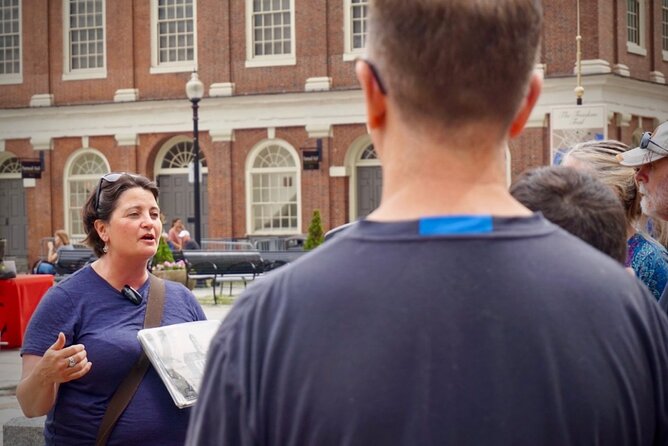
You’ll see 16 official landmarks in about 2.5 hours, and you get the kind of Q and A that turns street corners into backstory. The group stays small, with historians like Jon and Alejandro praised for pacing the facts clearly, answering questions, and keeping everyone engaged.
One thing to keep in mind: it is mostly an outside walking experience, with limited time to go inside buildings, so plan to see extra interiors on your own if you want that deeper dive.
Quick hits before you go
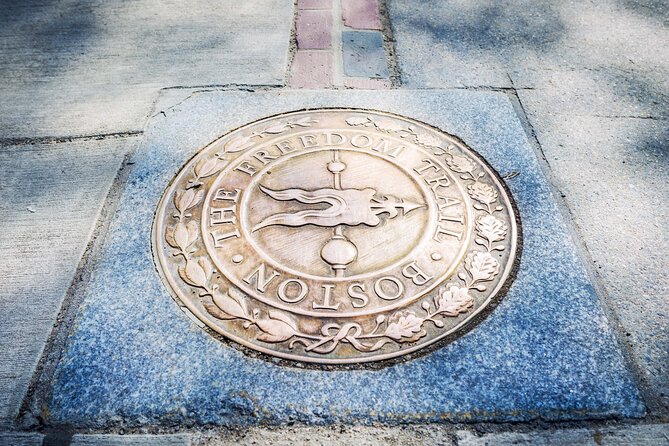
- 16 Freedom Trail landmarks covered on one route, from Boston Common to Copp’s Hill Terrace.
- Historian guide + real Q and A, with guides like Jon and Krista noted for answering questions and sticking to a clear timeline.
- Small group size (up to 16) helps you keep up and get answers.
- Accessible for strollers and wheelchairs, with the route designed for easy downtown walking.
- No Charlestown neighborhood stops, but you finish with views toward U.S.S. Constitution and Bunker Hill.
Other ways to walk the red brick, compared
Where this Freedom Trail walk starts and where it ends
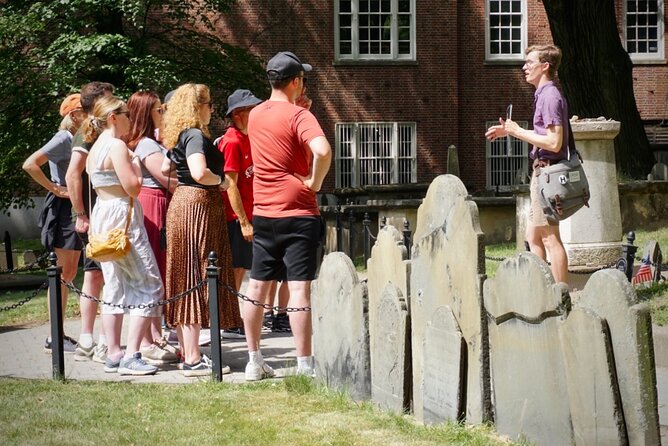
The meeting point is the Boston Foundation Monument at 49 Beacon St, just at the northern edge of Boston Common, opposite 50 Beacon Street. When your group checks in, you start right inside the park where the Revolutionary story feels immediate, not distant.
The tour ends at Copps Hill Terrace (520 Commercial St), overlooking the Charles River. From the terrace, you get big-picture context for how Boston worked as a coastline city, and you can look across to U.S.S. Constitution and toward Bunker Hill Monument.
If you like to plan your day, this is a smart finish. Hanover Street is close, so you can head for a casual meal on foot without scrambling for transit.
Why the 1760 to 1775 focus feels different than a basic history loop
A lot of Freedom Trail tours cover everything at once. This one narrows the scope to the American Revolutionary years between 1760 and 1775, so you feel cause and effect instead of dates floating around.
That narrower focus matters because you can connect bigger turning points to what you’re standing next to. The guide’s job is to connect the streets and buildings you pass to specific political and social shifts, including the tensions between British authority and local resistance.
It also helps you understand why events in 1770 and 1773 did not come out of nowhere. The tour gives you a timeline you can follow, and multiple guides were praised for keeping it chronological and clear.
Small-group format and historian storytelling that keeps moving
This is a small group walking tour, capped at 16 guests. That size is a big deal on the Freedom Trail, because you’re often walking through narrow, busy areas and stopping often. In a larger group, questions get lost. Here, you’re more likely to get answers that actually help.
The guides are consistently called out for being well-prepared and engaging, even in weather that can be brutal. On cold days, you may get warmth breaks, and guides were noted for using indoor space when possible.
You should still expect a steady walking pace. If you have trouble standing for long periods, this route may feel tiring because it is designed to cover multiple landmark stops without museum time replacing walking.
Stop-by-stop: from Boston Common to Granary Burying Ground
Your first major anchor is Boston Common, the oldest public land in the Americas and Boston’s communal grazing pasture dating to 1634. Right away, you get a sense of how public space shaped community life, not just government.
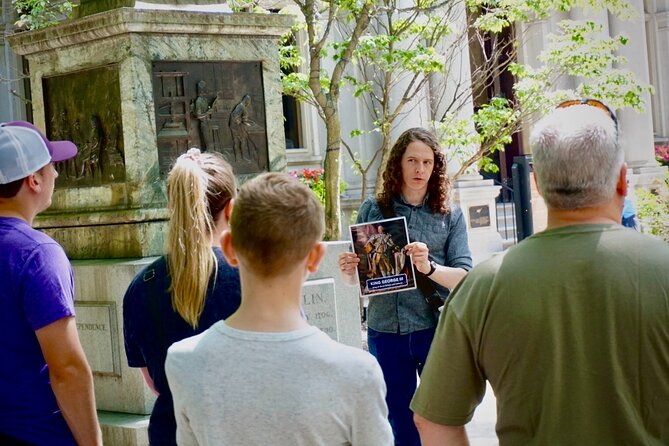
From there, you move to the Granary Burying Ground, Boston’s third-oldest burying ground and a final resting place for Revolutionary Boston residents. Cemeteries can sound like a slow start, but here they work because they link ordinary people to big events, and they add weight to the Revolution story.
Two things make this segment especially useful for first-time visitors:
- It gives you the emotional tone of the era, not just the political facts.
- The guide can explain how the city’s layout influenced movement, politics, and protest.
You also pass and learn about nearby religious and civic sites tied to the period, including congregational roots and older meeting places that shaped public discussion.
More of Boston from the top of the list
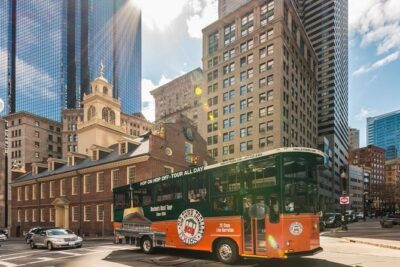

Benjamin Franklin area: schools, printing, and political momentum
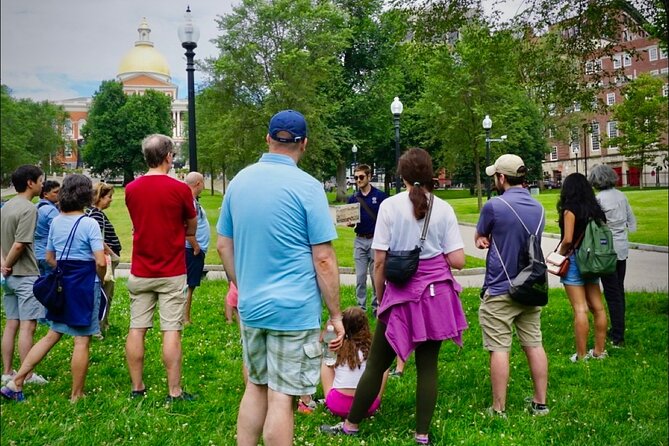
Next comes the Benjamin Franklin Statue stop. The big value here is how the guide uses the landmark area to connect education and civic life to the Revolution.
One standout thread is Boston Latin School, described in the tour context as the oldest public school in the Americas, dating to 1635. A lot of visitors see Franklin as a symbol. This stop helps you see him as part of a system that produced civic-minded leaders.
From there, the tour weaves through more political context tied to the 1700s, including long-running seats of power. Your guide also points out the former publishing house of Ticknor and Fields (1718) and other nearby structures tied to meetings and public debate.
This is also where the tour angle becomes practical: you start to understand why resistance took the shape it did. If you want a better sense of how information traveled in colonial Boston, this section is a helpful bridge.
The Boston Massacre site and the shift from argument to violence
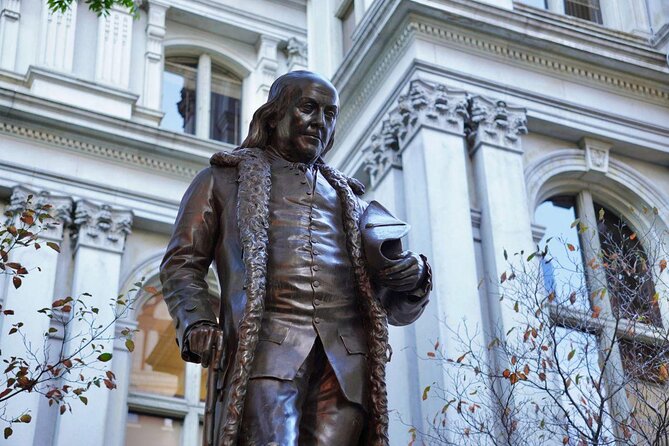
The Boston Massacre Site is one of the most emotionally charged stops on the route. The tour frames it around the killing of five Bostonians by British soldiers in 1770.
What I like about this stop is that it is not treated as a stand-alone tragedy. A strong guide connects it to the growing hostility that built over years, and that is exactly what you want from a Revolutionary-era walk.
Expect a pause that feels longer than it looks on the map. Guides were praised for making the story feel alive and for explaining what happened, why it mattered, and how it fed the next round of conflict.
If you care about the Revolution beyond patriotic slogans, this is the stop that helps everything feel real.
Faneuil Hall and the Cradle of Liberty
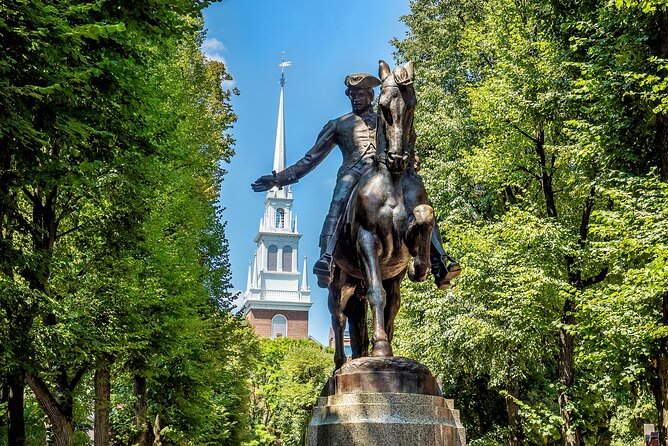
Then you reach Faneuil Hall Marketplace, known as the Cradle of Liberty. It’s described as the place hosted Boston town meetings and the focal point for public argument and civic decision-making as early as 1742.
This stop is valuable because it connects civic process to revolutionary action. You’re not just learning who fought. You’re seeing the machinery of local government that shaped popular resistance.
Also, the tour route includes nearby historic building context, and the area is a convenient break point in your walk. Even if you don’t go inside, you can feel why this spot became a magnet for political energy.
North Square Park, Paul Revere, and signal lanterns in the North End
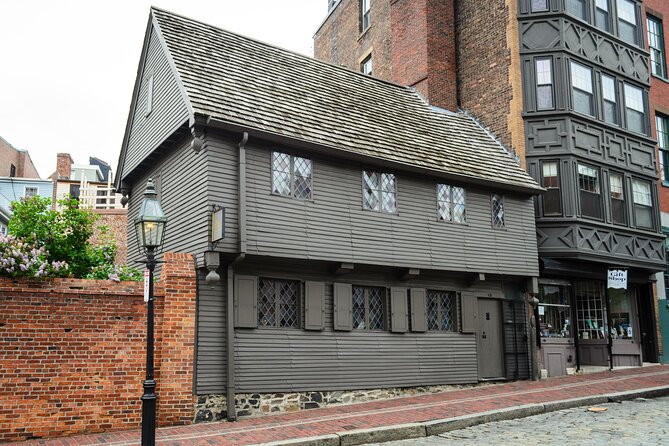
The tour heads into the North End area, starting with North Square Park. This is a historic public square from 1634, and it helps you picture how dense, active neighborhoods were part of the Revolutionary story.
Then the tour brings you to the Paul Revere Statue in a pedestrian-friendly space honoring the famous Midnight Ride (1775). This stop works well because it gives you a clear event to anchor the earlier tension to.
Right after, you get signal lantern context for the Midnight Ride, including the role of Boston’s oldest church held signal lanterns, described here as Old North Church, dating to 1723. This is one of those moments where the guide’s storytelling matters. It’s not just a fact, it’s the mechanism behind the myth, and it helps you understand what people needed to do to communicate quickly.
If you’re doing this tour as your first day in Boston, this is also where the city starts to click. Streets, churches, and squares stop being random. They turn into a route with meaning.
Copps Hill Terrace finale with views toward Constitution and Bunker Hill
The walk ends at Copps Hill Terrace, where you can look across the Charles River and understand the Revolution at a larger scale.
From the terrace, you’re pointed toward the U.S.S. Constitution and the Bunker Hill Monument battle context from 1775. It’s a smart closing move because it gives you a visual endpoint, rather than ending in a flat, busy sidewalk spot with no sense of what comes next.
This is also a good moment to take photos without needing to hustle to another attraction. You can linger, then head into the North End on foot for food and dessert.
What you get inside, and what you should plan to see later
This tour is built around walking and landmark storytelling, not museum time. Admission inside museums is not included, and time inside buildings is limited.
That said, there are smart options if you want extra interiors. The tour information notes that Old South Meeting House and Old North Church have discounted admission with the Hub Town Tour ticket, and you can book in advance or show your ticket on site. It also mentions Kings Chapel is expected to get this discount too.
So here’s the practical way to use this tour:
- Do the walking tour for context, timeline, and interpretation.
- Then choose one or two buildings you care about most for a follow-up visit.
If you’re the type who wants to tour interiors, or you want a deeper “inside the church” experience, you may feel rushed. A common theme from the experience feedback is that people would like more interior time, but the route is designed to cover everything efficiently.
Price and time: is $35.10 worth it for a 2.5-hour walk?
At $35.10 per person, this is not a budget-free tour, but it also isn’t priced like a museum ticket day. The value comes from a few clear factors.
First, you get a historian guide rather than just a self-guided map. Second, you cover all 16 official Freedom Trail landmarks in one route, and the tour is small-group sized. Third, it runs about 2 hours 30 minutes plus stops, which is short enough to fit into a busy day while still feeling like you accomplished something.
I also think the price makes more sense if you like asking questions. Reviews praised guides for being prepared and answering questions easily, which is where a guide can save you time later. Instead of researching each site one by one, you get a connected story while you’re there.
If you’re visiting Boston with a limited number of hours, this tour is a high-leverage way to get oriented fast.
Weather, walking comfort, and fitness reality
This is a walking tour with moderate fitness needs. It is described as not recommended if you have difficulty standing for extended periods. If that is you, consider asking for advice on pace and breaks before you book, or plan a shorter self-guided loop instead.
Also, the tour depends on good weather. When weather gets rough, the operator may cancel and offer another date or a full refund.
One encouraging detail from recent experiences is that guides were praised for handling cold days well and for trying warming spots indoors when possible. That means winter does not automatically ruin the day, but you should still dress for it like you mean it.
If you go in colder months, plan layers, gloves, a warm hat, and shoes with grip. You will thank yourself during the pauses between stops.
Who this tour is best for, and who might want a different option
This is ideal for:
- History buffs who want a Revolutionary-era timeline instead of general sightseeing.
- First-time Boston visitors who want a structured, efficient way to understand the Freedom Trail.
- People who like small-group discussion, not just a lecture you can’t hear.
It may be less ideal if:
- You strongly prefer museum time or lots of time inside churches and historic buildings.
- You want the full Freedom Trail experience in Charlestown itself, since this route is described as Downtown Boston and North End, and Charlestown neighborhood is not included.
Wheelchair and stroller access are called out as supported, which is a plus if your party needs that kind of route planning.
Tips to make the most of your Freedom Trail history walk
Here are the things I’d do if you want the best results from a tour like this:
- Come ready with one or two questions. A good guide can turn your questions into a deeper story.
- Treat it like a timeline lesson. If you remember the thread connecting 1760 through 1775, the landmarks start making sense instantly.
- Take breaks seriously. If you feel your legs going, slow down early and ask for a slower pace. The tour is built around stops, not speed racing.
Also, if you plan to visit one or two buildings afterward, pick them before the tour ends. You’ll be able to tell which sites feel most relevant to your interests.
Should you book this Freedom Trail history small-group tour?
If you want a smart first pass through the Freedom Trail with a historian guide and a strong Revolutionary focus, I’d book it. The small group size, the 1760 to 1775 storyline, and the efficient coverage of 16 official landmarks are exactly what most people need in Boston.
If you hate cold weather, have trouble standing, or you want a heavy inside-the-building day, you may prefer a different plan or pair this with only one later interior visit.
Overall, for the time you spend, this is a well-priced way to turn Boston landmarks into an understandable Revolution story.
FAQ
Where does the tour start and end?
The tour starts at the Boston Foundation Monument at 49 Beacon St, Boston, MA 02108, and it ends at Copps Hill Terrace, 520 Commercial St, Boston, MA 02109.
How long is the Boston Freedom Trail walking tour?
It lasts about 2 hours 30 minutes.
How many people are in the group?
This is a small group tour with a maximum of 16 travelers.
What landmarks are included?
The tour includes all 16 official Freedom Trail landmarks, and it covers Downtown Boston and the North End.
Is Charlestown included?
No, the Charlestown neighborhood is not included on this tour.
Is it accessible for wheelchairs and strollers?
Yes, the experience is wheelchair and stroller accessible.
Is museum admission included?
No, admission inside museums is not included.
What language is the tour offered in?
The tour is offered in English.
What is the cancellation policy like?
You can cancel for a full refund up to 24 hours in advance, and the experience may be canceled due to poor weather with an option for a different date or a full refund.
More Tour Reviews in Boston



Keep Going in Boston

The Red Line, Three More Ways


More around Boston, freshly written up
- The Boston Bash Scavenger Hunt★ 4.5 · 3 reviews
- Self-Guided Audio Tour of Boston North End★ 4.5 · 3 reviews
- Self-Guided Boston Christmas Tour★ 5.0 · 3 reviews
- Self Guided “The North End Pizza, Cannoli and Picnic” Solo Walking Tour★ 5.0 · 3 reviews
- Cambridge: Haunted Charles River Cruise★ 4.3 · 3 reviews
- Boston: Official Freedom Trail® Lantern Tour★ 4.7 · 3 reviews
Freedom Trail Walking Tours, compared.
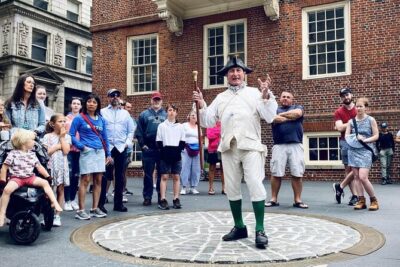 ★ 4.5Boston Freedom Trail Walking Tour with Costumed GuideFrom $262,531 reviews
 ★ 5.0Boston Food & History: Pizza, North End & Freedom TrailFrom $901,772 reviews
 ★ 4.9Boston’s Freedom Trail: A Revolutionary Walking TourFrom $311,748 reviews
 ★ 4.9Freedom Trail History Small Group Walking TourFrom $351,590 reviews
★ 5.0Boston’s Freedom Trail: A Revolutionary Walking TourFrom $311,343 reviews
★ 4.9Freedom Trail History Small Group Walking TourFrom $351,590 reviews
★ 5.0Boston’s Freedom Trail: A Revolutionary Walking TourFrom $311,343 reviews
 ★ 4.5Freedom Trail Walking Tour 250From $261,118 reviews
 ★ 5.0Boston Freedom Trail History Pub Crawl Small-Group TourFrom $60996 reviews
 ★ 4.6Official Freedom Trail® Walking TourFrom $18982 reviews
Also filed under