
REVIEW · FREEDOM TRAIL WALKING TOURS
Freedom Trail Experience
Freedom in Boston is easy to follow. This guided Freedom Trail experience connects the key Revolutionary sites from Park Street Church to the Paul Revere House, with a mobile ticket that keeps things simple. It runs about 1 hour 30 minutes to 1 hour 55 minutes and stays focused on the landmarks most people want to see.
I really like the way the stories are paced from stop to stop, from My Country ’tis of Thee at Park Street Church to the midnight ride start at the Paul Revere House. I also appreciate the mic and speaker setup, which makes it easier to hear the narration without straining, even in a group.
One thing to plan for: the Granary Burying Ground stop has stair considerations, and the Paul Revere House admission is not included. If either matters for you, check your comfort level ahead of time.
Key things to know before you go
- A tight 90-115 minute route that hits the Freedom Trail highlights without turning it into an all-day project
- Stop types that mix big moments and quick hits, from tombs to church history to statues
- Granary Burying Ground is a major anchor, with included entry and multiple famous graves nearby
- Clear audio in real-world conditions, including praise for mic and speaker delivery
- You’ll finish at the Paul Revere House area, so the day ends right where the story peaks
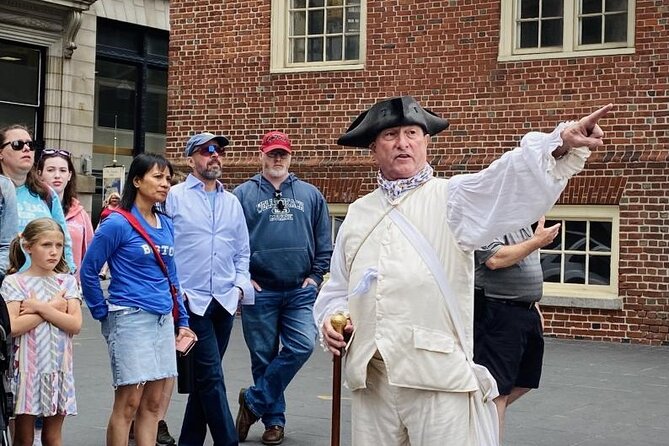
- Guide styles vary, but the best ones bring the era to life, including period clothing and even singing
Other ways to walk the red brick, compared
Why this Freedom Trail walk is good value at $35
At $35 per person for about 1 hour 30 minutes to 1 hour 55 minutes, this is a practical way to see a lot of Boston’s core Revolution sites without doing guesswork. Most stops are free to enter, and the tour includes admission at key moments like the Granary Burying Ground and the Paul Revere Mall portion, which helps the money feel less like a surcharge for just walking.
The real value, though, is the guided storytelling rhythm. Instead of bouncing between sites on your own and wondering what you’re looking at, you get a sequence that connects music, government, printing, conflict, and escape. That matters on the Freedom Trail because the places are close together, but the timeline can feel tangled if you’re trying to piece it all together solo.
Also, it’s offered in English and uses a mic and speaker. In a walking tour context, that’s not a tiny detail. It directly affects whether you come away feeling informed or just tired.
Start at 120 Tremont St, end at the Paul Revere House
The tour begins at 120 Tremont St and ends at the Paul Revere House area on N Square in the North End. That matters because it sets you up to continue your day in the direction of the North End if you want food or extra browsing afterward.
The route is designed as a chain. Some stops are quick, like the 2-minute stop at King’s Chapel. Others give you more time, like the 15 minutes at the Paul Revere House. You’re not expected to linger at every single site. Instead, you get a guided hit, a clear takeaway, and then you move on.
Group size is capped at 30 travelers, which is a sweet spot for this kind of walking tour. Smaller groups are easier, but even at 30 the mic helps keep the experience manageable.
One more planning note: this tour is commonly booked about 32 days in advance on average. If you travel in a busy season or on a popular day, buying earlier usually saves stress.
Park Street Church: where a national song ties to Revolution-era Boston
You kick things off at Park Street Church, a spot with a special kind of hook. This is where the song My Country ’tis of Thee originated, and the church also sits on an important Revolutionary site. That combination works well because it turns what could be a generic church stop into a story about sound, identity, and the era’s mindset.
If you’re the type who likes to understand why a landmark matters, this opening is smart. It gives you a theme right away, and it sets up a tour where buildings and street corners are treated like evidence, not just scenery.
This stop is free and short, about 5 minutes, so keep your eyes up and listen closely. The guide’s narration is what makes the minutes feel worth it.
Granary Burying Ground: tombs that anchor the whole Freedom Trail
Granary Burying Ground is the heavy-hitter stop. It’s described as the largest part of the Freedom Trail, made up of multiple important points. The focus lands on the tombs of Samuel Adams, Paul Revere, and John Hancock, among others.
This is also where the tour starts to feel less like sightseeing and more like understanding legacy. When you stand near Revolutionary leaders and then hear connected stories about what they did, the names stop being homework and start becoming people.
Practical note: the tour includes admission here, and dogs cannot enter the Granary Burial Ground. If you’re traveling with a dog, plan around that rule.
Accessibility is also addressed. If you cannot climb stairs, you can enter the Granary Burying Ground from a separate entrance. If that applies to you, it’s worth planning your pace and making sure you’re set up before you arrive, since the rest of the route is still a walking experience.
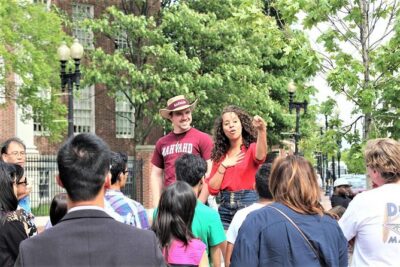


King’s Chapel and Boston Latin School: institutions that kept turning the page
After the cemetery, the tour moves into Revolutionary-era Boston institutions.
At King’s Chapel, you’re looking at Boston’s first Anglican church in a town that was at war with the crown. The building is said to house stories spanning over 300 years, and that long timeline is exactly the point. It helps you see the Revolution not as a sudden explosion, but as something that happened inside a place with deep roots and changing leadership.
Then comes Boston Latin School, presented as the first public school in America. The narration connects it to education for some of America’s founding fathers. Even with only about 5 minutes at the stop, this is an effective reminder that revolutions are not only about battles. They’re also about ideas, training, and who gets access to learning.
Both stops are free. They also work well back-to-back because they shift you from personal legacy (graves) to civic legacy (schools and religious institutions).
Franklin’s statue: a quick lesson in Revolutionary influence
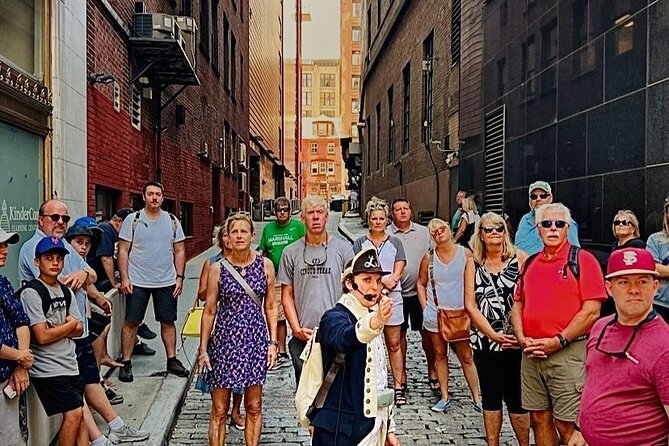
The statue of Benjamin Franklin is a short stop, around 5 minutes, and that’s fine. The aim here is not a long museum-style visit. It’s a moment that gives you Franklin’s Boston role during the American Revolution, so you’re not missing one of the era’s biggest names while rushing past street corners.
This stop is free and simple, but it’s a useful “compression point.” If you tend to forget details when you’re moving quickly, this is where the guide helps you glue the facts together.
Old South Meeting House and the Boston Tea Party story
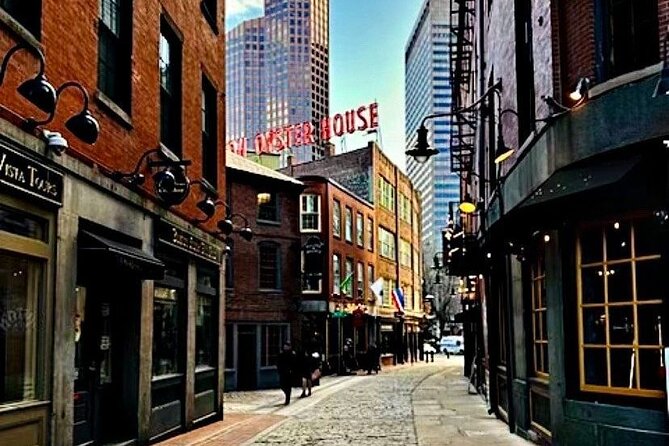
Next you hit Old South Meeting House, and the centerpiece is the story of the Boston Tea Party beginning there. The stop is about 5 minutes, and it works because the meeting house context explains why people got angry enough to take dramatic action.
This is another free stop, and it’s a good one if you like narrative clarity. The Freedom Trail can feel like a string of photos, but this part is about cause and reaction.
If you want your Revolution tour to feel like a story with turning points, this is where you start to get that sense.
Boston Massacre site: hear it with a costumed guide
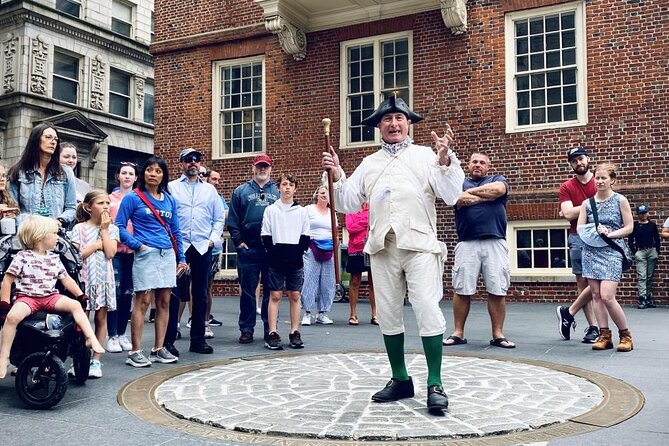
Then you come to the Boston Massacre site, again with a free stop time around 5 minutes. Here, the tour leans into storytelling style, described as a colonial costumed guide.
This is where the mic plus guide performance tends to matter most. A short stop like this can go two ways on a walking tour. Either it becomes a fast glance and a shrug, or it becomes one of the moments you remember when you’re back at your hotel trying to explain what you saw. The setup here is designed for the second outcome.
Even if it’s a quick stop, the goal is to make the scene understandable, not just dramatic.
Old Corner Bookstore: where Paul Revere’s Ride was published
Old Corner Bookstore is one of those stops that feels like a shortcut to the way information moved during the Revolution. You get to see the place where Paul Revere’s Ride was originally published and hear about it.
This is a free stop about 5 minutes, so again, it’s not meant to replace a book. It’s meant to connect the man to the printing and distribution of images and ideas. That matters, because during the Revolution era, messages traveled fast and propaganda could shape public opinion.
If you like the intersection of politics and media, this stop tends to hit.
Old State House: colonial government in the same loop as the conflict
Then you reach Old State House, which the tour frames as the center of colonial government and also near the site of the Boston Massacre. It’s about 10 minutes and free.
This portion is valuable because it gives you structure. It’s not only about what people did when they were angry. It’s also about who ran the machinery of power before things snapped. When you stand here right after the Massacre story, it can help you connect events to institutions without needing extra reading.
If you’re trying to understand why tensions escalated, this stop can be a helpful anchor.
Paul Revere House: the big finish that needs extra planning
The tour reaches the Paul Revere House, and this is the star of the ending. The house is described as Boston’s oldest residential house from 1680, and it’s tied directly to the start of the famous midnight ride.
You’ll have about 15 minutes at the stop, which is a meaningful chunk for a walking tour. But here’s the important catch: admission is not included.
That means you should decide in advance whether you want to buy the ticket for the indoor experience. If you know you’re very interested in the midnight ride story and want more than exterior context, budget for it.
If you’re fine with a look and moving on, you can still enjoy the setting and the guided narrative. Either way, the Paul Revere House stop sets you up for a satisfying ending because the tour finishes in the same North End pocket where you can keep exploring afterward.
Paul Revere Mall and Old North Church area: statue moments that close the loop
Finally, you wrap up at Paul Revere Mall, where you see the famous statue of Paul Revere and the connection to the Old North Church. This stop is about 10 minutes and includes admission.
This is a good closing beat because it’s a visible, memorable landmark. After church history, graves, institutions, printing, and government, you end with a statue tied to the midnight ride story. It’s a clear way to tie the whole Freedom Trail theme together.
Also, by the end you’re already in position for any late-afternoon plans in the North End.
Sound, pacing, and why the rain does not cancel the story
Because this is a walking tour, pacing matters. You’ll be on your feet for roughly 1 hour 30 minutes to 1 hour 55 minutes, with stops ranging from about 2 minutes to 15 minutes.
The mic and speaker setup comes up in standout reviews, and that makes sense. In a city setting, it can be hard to hear if groups cluster or if there’s background noise. The mic helps you stay in the story instead of playing guessing games.
The pace also gets attention. Some guides were praised for adjusting to physically slow walkers and keeping everyone together when plans shifted. That kind of flexibility matters on a short, stop-heavy route.
Rain is not treated as a deal breaker either. If bad weather is on the forecast, plan for it like you would for any Boston walk, bring a jacket, and expect the narration to keep rolling.
Guides to look out for, and what their styles add
Guide style seems to be a big part of why this tour performs well. Different names show up, and each adds a slightly different flavor.
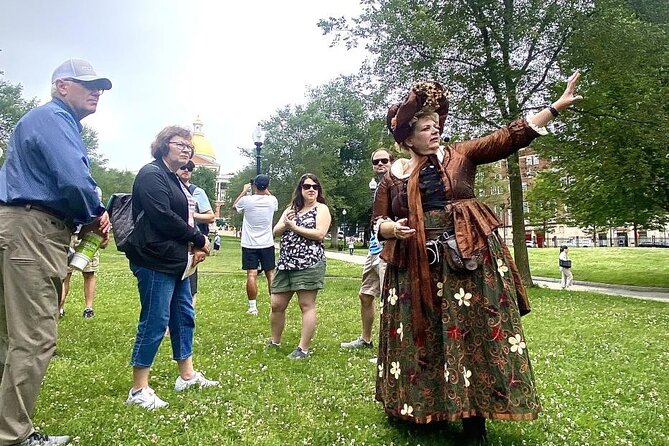
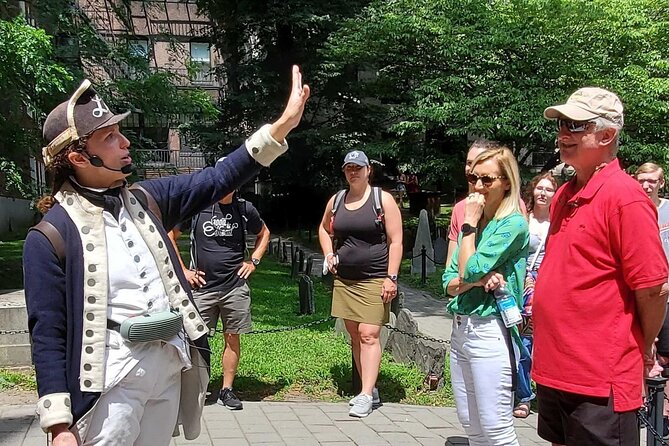
Roseli is called out for making the Freedom Trail come alive with facts and events that connect. Sarah gets praise for using the mic and speaker so hearing is easy, and for an enjoyable tour style. Jeremiah Poope is described as personable and fun. Geoff shows up in period clothing and keeps things engaging with his command of the material. Mother Goose, also referenced as Elaine, is especially memorable for storytelling that included singing My Country ’tis of Thee, plus keeping pace comfortable for someone with slower movement. One more note: when a group had to be doubled temporarily, Elaine was credited with keeping people together.
So if you’re the type who wants a guide to be part performer, part teacher, this tour is set up for that. If you prefer strict museum quiet, you might still do fine, but this is clearly a guided narrative walk.
Should you book the Freedom Trail Experience?
Book this tour if you want:
- A focused Freedom Trail hit in about 90 to 115 minutes, not a full day project
- Most stops that are free, plus included admission at key points
- A guide-led story that ties together song origins, Revolutionary figures, government, protests, and the midnight ride
- Strong audio support through a mic and speaker
- A manageable group size, capped at 30
Skip or rethink it if:
- You need extensive wheelchair or step-free time at every stop. The Granary stop has stair considerations, though there is a separate entrance option if you cannot climb stairs.
- You are not willing to pay extra for the Paul Revere House ticket since admission there is not included
- You want long, independent time inside buildings rather than brief, guided visits
If you’re in Boston for a short stay or you want one sure way to orient yourself, this is a solid choice. The ending at the Paul Revere House gives you a strong finish, and the story chain along the way helps the Freedom Trail feel like more than a checklist.
FAQ
How long is the Freedom Trail Experience tour?
It runs about 1 hour 30 minutes to 1 hour 55 minutes.
How much does the tour cost?
The price is $35.00 per person.
Where does the tour start and where does it end?
It starts at 120 Tremont St, Boston, MA 02108, USA, and ends at The Paul Revere House, 19 N Square, Boston, MA 02113, USA.
What is included in the tour ticket?
You get a mobile ticket. Admission is included at the Granary Burying Ground and the Paul Revere Mall stop, while Paul Revere House admission is not included.
Is this tour offered in English?
Yes, it is offered in English.
Are service animals allowed and can dogs enter Granary?
Service animals are allowed. Dogs cannot enter the Granary Burying Ground.
More Tour Reviews in Boston



The Red Line, Three More Ways


More around Boston, freshly written up
- The Boston Bash Scavenger Hunt★ 4.5 · 3 reviews
- Self-Guided Audio Tour of Boston North End★ 4.5 · 3 reviews
- Self-Guided Boston Christmas Tour★ 5.0 · 3 reviews
- Self Guided “The North End Pizza, Cannoli and Picnic” Solo Walking Tour★ 5.0 · 3 reviews
- Cambridge: Haunted Charles River Cruise★ 4.3 · 3 reviews
- Boston: Official Freedom Trail® Lantern Tour★ 4.7 · 3 reviews
Freedom Trail Walking Tours, compared.
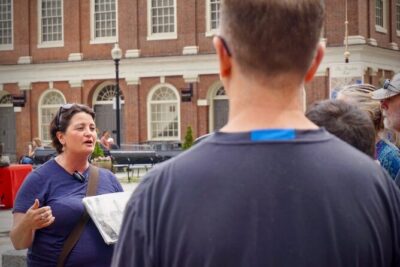 ★ 5.0Freedom Trail History Small Group Walking TourFrom $356,450 reviews
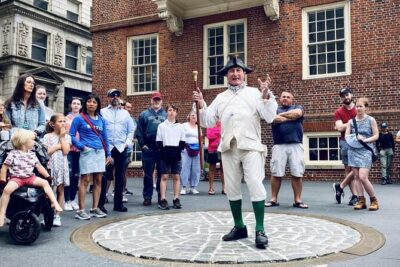 ★ 4.5Boston Freedom Trail Walking Tour with Costumed GuideFrom $262,531 reviews
 ★ 5.0Boston Food & History: Pizza, North End & Freedom TrailFrom $901,772 reviews
 ★ 4.9Boston’s Freedom Trail: A Revolutionary Walking TourFrom $311,748 reviews
★ 4.9Freedom Trail History Small Group Walking TourFrom $351,590 reviews
★ 5.0Boston’s Freedom Trail: A Revolutionary Walking TourFrom $311,343 reviews
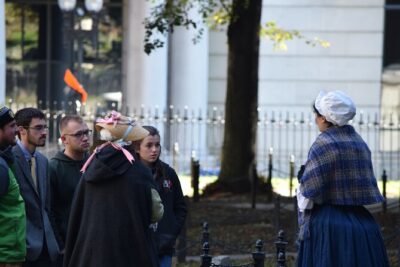 ★ 4.5Freedom Trail Walking Tour 250From $261,118 reviews
 ★ 5.0Boston Freedom Trail History Pub Crawl Small-Group TourFrom $60996 reviews
Also filed under