

REVIEW · NEW ENGLAND SELF-GUIDED AUDIO TOURS
Plymouth Pilgrims Self-Guided Walking Audio Tour
Plymouth gets real fast when audio starts. This self-guided walking audio tour strings together the best-known Pilgrim landmarks and adds stories you can hear at your own pace, all the way to Plimoth Plantation, with lifetime access.
I especially like the hands-free, location-triggered playback. You follow the prompts, and the next story starts when you reach each spot, so you are not constantly stopping to tap or read. I also like how it organizes the walk around iconic sites, from Mayflower II and Plymouth Rock to Old Burial Ground and the working Plimoth Grist Mill.
My main caution is that it depends on your phone working smoothly. If you do not download on strong Wi-Fi or you start the app from the wrong place, the tour can be slow to start, and some parts involve uphill walking that is easier to do with good shoes.
Key things to know before you go

- Offline audio and maps after download, so you are not hunting for signal while walking.
- Location-triggered stories that play automatically when you get to each stop.
- More than 24 audio stories over about 1 mile, usually taking 1 to 2 hours, with an overall booking window of 2 to 3 hours.
- Recommended stop time is about 10 minutes at most sites, plus a shorter break at Long Beach Rock.
- No staff meet-up at the start, so you will need to start the first story on-site yourself.
More routes you can walk at your own pace
Price and value, what $14.99 actually buys
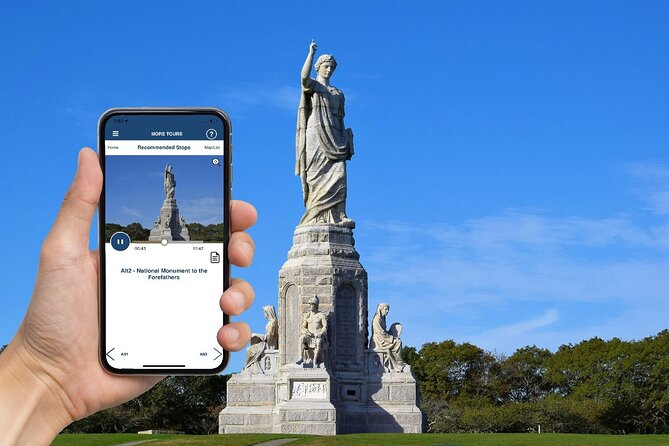
At $14.99 per person, this is not priced like a quick hop-on narration. You are paying for a guided experience you can reuse later, because the tour is set up for new lifetime access, no expiry.
For the money, you get a full walking route with audio content built around multiple major stops. It also includes offline maps and location-based playback, which is the difference between reading a few plaques and actually walking through a connected storyline.
Where the value can slip is if you only care about one or two headline sights. If you mostly want Mayflower II and Plymouth Rock, you may feel the cost is heavy compared with doing those two things on their own.
How the audio tour works in real life (and why it matters)
This tour is self-guided. No one meets you at the start, and you begin by finding the first story location, then following the audio cues to the next stop.
After booking, you get a password by email and text, and you are instructed to download the separate tour app by Action. The tour notes also say you should have strong Wi-Fi or cellular while downloading, and that you may need about 30 minutes after downloading to receive all the info needed to start.
Why that matters: a walking tour is only fun when it starts quickly. If the app is not downloaded yet, or you launch the wrong tour version, you can lose time and end up doing manual starts instead of the smooth automatic flow.
Getting the route right, start at 136 Water St, end at Plimoth Patuxet
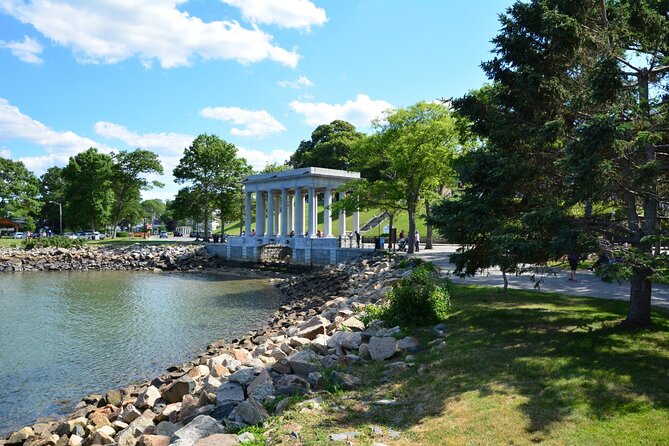
The tour start is at 136 Water St, Plymouth, MA 02360. The tour ends at Plimoth Patuxet Museums, 137 Warren Ave, Plymouth, MA 02360.
This is a point-to-point walk, not a loop. Plan on that when you park, and keep in mind the route is about 1 mile long, with more than 24 audio stories.
Also, the tour is hands-free as long as you stay on route and keep moving at a reasonable pace. If you wander far off the suggested path, GPS-triggered audio may get out of sync.
Stop-by-stop: from the Visitor Information Center to Mayflower II
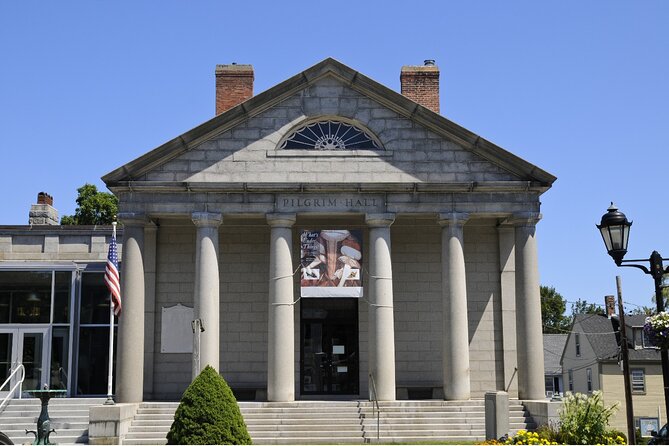
Stop 1: Plymouth Visitor Information Center
This is your orientation hub. The Visitor Information Center is a major stop for travelers heading to and from Boston, Cape Cod, and throughout New England, so the audio starts with helpful context before you dive into the famous sites.
Practically, this stop is also where you can get your bearings. If your phone needs a minute to connect to GPS or the audio to begin cleanly, this is a good place to handle that without rushing.
Stop 2: Mayflower II
Mayflower II is a reproduction of the Mayflower that carried the Pilgrims in 1620. The reproduction was built in Devon, England during 1955 to 1956, in a collaboration involving Warwick Charlton and Plimoth Plantation.
What I like about hitting Mayflower II early is that it anchors the rest of the walk. Even if you have seen photos before, hearing the ship story right after you start helps the later stops feel less like random monuments and more like one continuous theme.


Mayflower Society House to Plymouth Rock, symbol and family stories
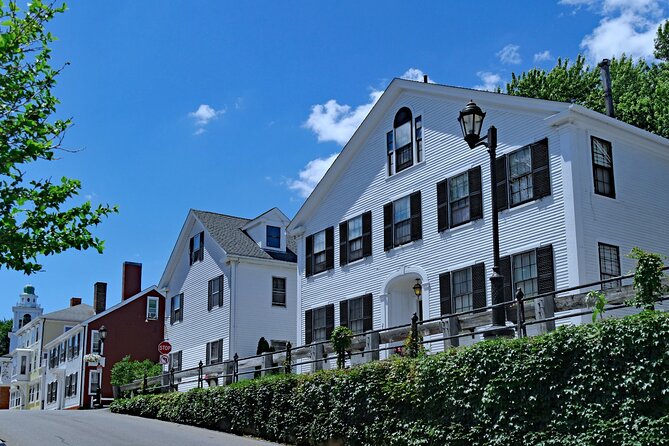
Stop 3: Mayflower Society House
This is across the street and up the hill from Plymouth Rock. The building is an 18th century home originally built by Edward Winslow’s descendant, Edward Winslow’s great-grandson, and its story runs across three centuries.
The audio coverage connects the Winslow family to major American turning points, including Loyalists during the Revolutionary era. It also mentions a romantic landmark, when Ralph Waldo Emerson and Lydia Jackson exchanged vows, and it notes the 1898 restoration by architect Joseph Everett Chandler. The house later served as a Red Cross headquarters during World War II.
This stop is valuable because it is not just Pilgrims, it is the ripple effect. You get a sense of how one early family and one preserved home can carry layers of later history.
Stop 4: Plymouth Rock
Plymouth Rock is the traditional disembarkation site for William Bradford and the Mayflower Pilgrims in December 1620. The audio keeps it focused, so it works well even if you are not staying long.
Quick tip: take your time here. You have a lot of stops after this, so it helps to slow down at the most symbolic one and let it land.
Massasoit through Brewster Gardens, the walk adds wider context

Stop 5: Massasoit Statue
This statue by Cyrus Edwin Dallin was completed in 1921 for the three hundredth anniversary of the Pilgrims’ landing. The sculpture represents Pokanoket leader Massasoit welcoming the Pilgrims on the occasion of the first Thanksgiving.
Why this stop is worth your time: it shifts your focus from Europeans alone to the people already living here. Even if you think you know the story, listening to it in the open air near the statue makes it feel more grounded than a textbook summary.
Stop 6: Brewster Gardens
Brewster Gardens is named for William Brewster, one of the Mayflower passengers. It is a calmer pause in the route, and it helps break up the more intense, landmark-heavy stops.
Stop 7: Pilgrim Maiden Statue
This is the Pilgrim Maiden by Henry Hudson Kitson (1922). The audio points out that it honors Plymouth’s immigrant settlers from 1700 to 2000, and it also highlights the English women whose courage and devotion helped shape the new nation.
If you care about who is usually missing from “founder” stories, this is a smart place to stop and listen longer than the recommended minutes.
Old Burial Ground and the Richard Sparrow House, early Plymouth still feels close

Stop 8: Old Burial Ground (Burial Hill)
Old Burial Ground is a historic cemetery on School Street, established in the 17th century. It is the burial site of several Pilgrims and was listed on the National Register of Historic Places in 2013.
This stop is quieter, and that is the point. The audio frames why these places matter, and it gives you a chance to absorb how small the early settlement really was.
Stop 9: Richard Sparrow House (1640)
This historic house at 42 Summer Street is described as the oldest surviving house in Plymouth. It was built around 1640 by Richard Sparrow, an English surveyor who arrived in Plymouth in 1636.
The house works best when you treat it like a time capsule. Walk slower, look around, and let the narration connect the structure to early Plymouth life.
Plimoth Grist Mill to Pilgrim Hall Museum, daily life and big ideas

Stop 10: Plimoth Grist Mill
Plimoth Grist Mill is a working grist mill reconstruction of the original Jenney Grist Mill, built on the site of the original mill. Hearing about milling right in front of a functional, recreated mill makes the everyday feel more tangible.
Even if you only pause briefly, the audio helps you understand why survival depended on food, grain, and basic technology.
Stop 11: Pilgrim Hall Museum and interpretive focus
Pilgrim Hall Museum at 75 Court Street is noted as the oldest public museum in the United States in continuous operation, opening in 1824.
The audio also emphasizes exhibits tied to Pilgrims’ faith and values, and it includes coverage related to abolitionists and slavery, plus the role of family as a cornerstone of society.
This is one of those stops where the audio can steer your thinking. If you want a museum-style interpretation without paying for extra entrances right then, the audio gives you a solid framework.
Hedge House and Jabez Howland House, Plymouth families over time
Stop 12: Hedge House
Hedge House is the Plymouth Antiquarian House, built in 1809 for William Hammatt, a New England sea captain. The Hedges, an entrepreneurial family, purchased it in 1830 and lived there until 1919.
You get a sense of Plymouth shifting from the earliest settlement story to later New England prosperity and family life.
Stop 13: Jabez Howland House
The Jabez Howland House at 33 Sandwich Street has an oldest portion built by Jacob Mitchell in 1667. It was purchased by Jabez Howland, son of Mayflower passengers John Howland and Elizabeth Tilley Howland.
This stop is useful if you want the audio to connect ancestry, property, and lived experience, not just big events.
Long Beach Rock and the endgame at Plimoth Plantation
Stop 14: Long Beach Rock
Long Beach is described as a barrier beach, a peninsula that acts as a buffer between the open ocean and the mainland coast. The stop is short, but it adds a coastal shift so the route does not stay trapped in one kind of historical scene.
If you tend to forget that Plymouth was a coastal community, this kind of interruption helps.
End: Plimoth Plantation
The tour ends at Plimoth Patuxet Museums. Plimoth Plantation is a living history museum founded in 1947 that attempts to replicate the Plymouth Colony settlement from the 17th century.
The audio tour sets you up well for that final transition. You finish with context, then you can keep exploring on your own time.
Practical note: the walking route includes hills. If you have a slower walking pace, build in extra time at the middle stops and plan a calmer end.
What to bring, and how to make the walk feel easy
This tour runs best with headphones. The tour guidance specifically suggests bringing earbuds or headphones, and the app is designed for hands-free listening.
I also recommend downloading the tour before you arrive, on strong Wi-Fi if possible. The download is where you avoid most of the frustration, since the tour is meant to work offline once it is downloaded.
If you are traveling as a couple, there is a savings-minded tip: you can share one tour by splitting headphones. Just be realistic about volume, because you will both want to hear the stories clearly.
Who this audio tour is for (and who should skip)
This tour is a great fit if you want to see several classic Plymouth landmarks in one outing and you like moving at your own pace. It is also a solid choice for times when museums and attractions have limited hours, because the audio still gives you the story connections even if you do not go inside everything.
It is less ideal if you want a staff-led experience with included admission into everything you stop at. The tour price covers the audio walking guide, and the notes say attraction passes, entry tickets, or reservations are not included.
It also takes basic comfort with a longer walk. It is over 1 mile, with more than 24 stories, so wear shoes you trust.
Should you book the Plymouth Pilgrims audio tour?
Yes, if you want a budget-friendly way to stitch together Mayflower II, Plymouth Rock, Burial Hill, and Plimoth Plantation into one coherent walk. The strongest reason to book is offline audio with automatic, location-triggered stories, plus lifetime access so you can reuse it if you come back.
I would hesitate if you know your phone downloads poorly, you cannot reliably get strong Wi-Fi on arrival, or you are expecting a quick 30 minute overview with no walking. The cost feels fair when you use the full route, but it can feel steep if you only want a couple of sites.
FAQ
How much does the Plymouth Pilgrims self-guided walking audio tour cost?
It costs $14.99 per person.
How long is the tour?
The tour is listed as about 2 to 3 hours. The route is over 1 mile long, with more than 24 audio stories, and it takes about 1 to 2 hours to complete.
Where does the tour start and end?
It starts at 136 Water St, Plymouth, MA 02360, USA. It ends at Plimoth Patuxet Museums, 137 Warren Ave, Plymouth, MA 02360, USA.
Do I need a cellular signal during the walk?
No. The tour includes offline maps, and it is designed to work offline after you download the tour in advance.
How do I access the tour on my phone?
After booking, you receive an email and text with setup instructions and a password. You download the separate Action tour app, enter the password, then launch the tour on-site from the first story point.
Is the tour truly self-guided?
Yes. No one meets you at the start. You walk and follow the audio cues, and the audio plays on its own based on your location.
What do I get access to after I buy?
You get new, lifetime access with no expiry, and you can use it anytime, on any trip, as many times as you want.
Are attraction entry tickets included?
No. Attraction passes, entry tickets, and reservations are not included.
What devices are recommended?
The guidance recommends an iPhone running iOS 15 or later, an Android device running version 9 or later, or an iPad or tablet with GPS and cellular connectivity.
Can I cancel for a full refund?
Yes. Free cancellation is available, and you can cancel up to 24 hours in advance for a full refund.
More Tours in Plymouth


More Tour Reviews in Plymouth

More Routes at Your Own Pace
More around Plymouth, freshly written up
- Day Tour of Plymouth and Cape Cod from Boston★ 4.5 · 14 reviews
- Plymouth Pilgrims Self-Guided Walking Audio Tour★ 4.0 · 28 reviews
- Plimoth Patuxet Museums★ 4.5 · 463 reviews
New England Self-Guided Audio Tours, compared.
 ★ 4.5Scenic Newport, RI Self-Guided Driving Audio TourFrom $16325 reviews
 ★ 4.5Self Guided Classic Freedom Trail Location Aware (GPS) Walking Audio TourFrom $7258 reviews
 ★ 4.5Self-Guided Smartphone Ghost Walking Tour in SalemFrom $7225 reviews
 ★ 4.0Cape Cod & Provincetown Self-Guided Driving & Walking Audio TourFrom $24207 reviews
 ★ 4.5Boston Freedom Trail Self-Guided Tour with Audio Narration & MapFrom $998 reviews
 ★ 4.0Newport Cliff Walk Self-Guided Walking TourFrom $1479 reviews
 ★ 4.5Ultimate Historic Salem and Witch Trials Self-Guided Walking TourFrom $1667 reviews
 ★ 4.0Lexington & Concord Self-Guided Driving & Walking Audio TourFrom $1462 reviews