

REVIEW · REVOLUTIONARY BOSTON HISTORY TOURS
Boston’s Old State House & Old South Meeting House Museums
Revolution starts in these two rooms. This pair of Boston museums traces how colonial crowds turned outrage into action, with artifacts, exhibits, and photo-worthy American Revolution details across two historic buildings. I especially like the convenience of Old South Meeting House and Old State House being so close, you can stack them without wasting a day.
I also like how the exhibits make the story feel concrete, not just dates on a wall, with the Meeting House connected to mass meetings and the State House tied to royal government and dramatic events like the Boston Massacre. One drawback to plan for: the Old State House is not currently accessible, so if you need step-free access, you’ll want to factor that in.
If you’re short on time but still want the good stuff, this combo works. You get a flexible visit window, a mobile ticket, and options for talks or walking tours so you can go faster or slow down depending on your interest.
Key things to know before you go
- Two buildings, two-block feel: Old South Meeting House and Old State House sit close enough to connect easily on foot
- Tea Party origins at Old South Meeting House: Learn how Boston protest culture formed in a massive 1729 meeting space
- Revolutionary-era artifacts at Old State House: The museum focuses on royal government and key dramatic events, including the Boston Massacre
- Mostly self guided, with add-on tours: You can walk at your own pace, then choose tours or programs if you want more structure
- Air conditioning in both sites: Reviews call out AC, which matters in hot or muggy weather
- Accessibility is uneven: Old South is accessible, while Old State House is not currently accessible
More of the revolution, from the tea to the bridge
Old South Meeting House: the 1729 meeting hall behind the Tea Party
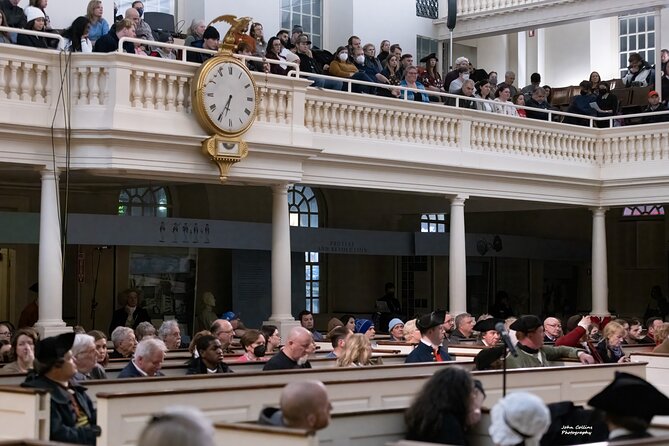
Old South Meeting House was built in 1729 and served as the biggest building in colonial Boston. It’s hard to overstate what that means for the story, because scale matters when you’re talking about public pressure. This is a space built for getting lots of people together, and that’s exactly what you see tied to the mass meetings that helped set the stage for the Boston Tea Party and the American Revolution.
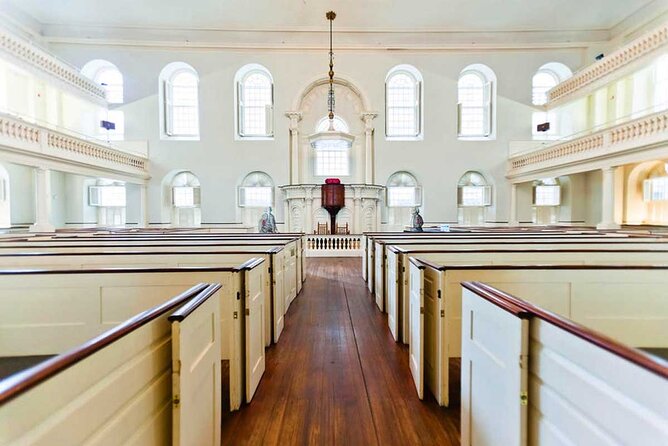
When you visit, expect museum exhibits and educational programming in a setting that still feels like a meeting place, not a generic warehouse. The building is famous for its layout, including church features like parishioner boxes, which help you picture how ordinary people sat, watched, listened, and reacted. It also makes the political process feel more human. You’re not only learning why events happened, you’re seeing the kind of environment where defiance could be discussed out loud.
A practical plus: the site is described as easy to navigate, and there are tours and public programs available if you want a bit more direction. One review note that pairing a guided tour before coming back made the exhibits click faster. So if you’re the type who likes context first, then detail second, you’ll like that two-step approach.
Potential drawback: the main value here is historical interpretation, not interactive “hands-on” stuff. If you’re hoping for lots of modern-style activities, you might find it more museum-and-explanation than hands-on.
Old State House: 1713 royal power, Boston Massacre fallout, and artifacts you can see

Old State House was constructed in 1713 and became the center of royal government in the Massachusetts Bay colony. That matters because it puts you at the physical heart of the conflict. When protests escalated, this was one of the places where the government’s presence was felt, including around dramatic moments like the Boston Massacre.
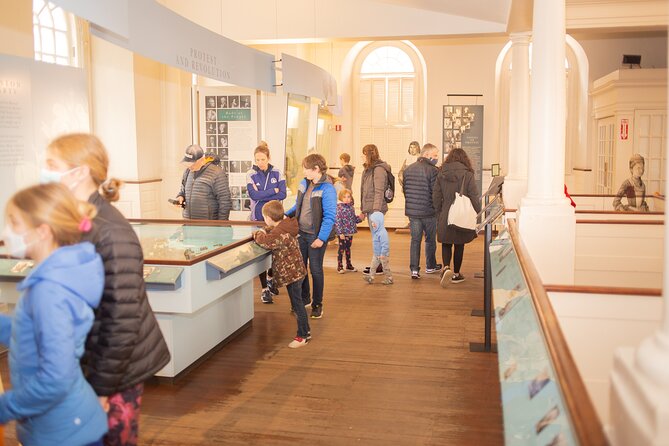
The museum experience focuses on thought-provoking exhibits and visuals, plus educational offerings and walking tours. You’ll want to give it time to breathe, because the exhibits are designed to connect events leading into the Revolutionary War, not just list them. Reviews specifically highlight that the State House has many artifacts connected to those events, which is exactly what makes it different from a quick stop. Artifacts help you feel how real the past was, not just how it reads in a textbook.
You’ll also get a good sense of how power and public life collided in a single downtown address. That makes the State House a great follow-up to Old South. Old South helps you understand how crowds organized and spoke up. Old State shows where that tension landed, and what it looked like when authority and resistance collided.
One consideration is accessibility. The Old State House is not currently accessible, while Old South Meeting House is accessible. If accessibility matters for your group, plan your route with that in mind so nobody is stuck deciding on the fly.
Another small but real note from reviews: both sites have AC, and on a warm day that can be the difference between rushing and actually enjoying the exhibits.
How the visit flows: self guided pace with options to add structure
This is set up as a self guided experience across the two historic sites. That’s a big deal if you like control. You can move quickly if you’re doing a tight Freedom Trail day, or you can slow down and linger where a display grabs you.
A helpful strategy is to think of the visit as two layers. First layer is orientation: walk through, get your bearings, and read enough to connect the major events. Second layer is meaning: come back to the details that align with what you learned earlier, like artifacts and explanations of key turning points.
There are also talks and tours available, and both museums describe walking tours and public programs. If you’re the type who learns best with someone framing the story out loud, adding a tour around one of the stops can make the exhibits feel less like separate displays and more like a continuous narrative.
If you’re combining this with other Boston highlights, the closeness of the two sites helps you keep momentum. You can treat them like one connected “mini-episode” of the Revolution rather than two unrelated museum stops.
The walk and timing: downtown convenience without the time crunch
These two museums are close enough that you can realistically keep your day moving. They’re located in the heart of downtown Boston, with Old South Meeting House noted as just two blocks from the Old State House. That walking distance is exactly what you want when you’re trying to fit in other attractions or keep your day family-friendly.
Hours run daily from 10:00 AM to 5:00 PM during the listed period (January 1, 2026 through June 30, 2026). So if you’re visiting outside those dates, you’ll want to double-check hours for the exact day you’re going, because this info is tied to that specific window.
Duration is listed as roughly 30 minutes to 2 hours, which is a wide range for a reason. If you do quick exhibit reading and a photo stop, you can be done faster. If you take your time with visuals, artifacts, and any optional tours or programs, you can easily stretch it toward the longer end.
What I’d plan: for many people, about 45 to 60 minutes total works well if you’re steady and focused. If history is your main priority, 90 to 120 minutes lets you enjoy both without feeling like you’re sprinting.
More of Boston from the top of the list



Price and value: why this $15 combo can fit even a tight budget
The price is listed at $15.00 per person, and the experience uses a mobile ticket. On the itinerary, admission is marked free for both Old South Meeting House and Old State House, which suggests you’re buying the bundled entry or experience access for the pair rather than paying separate museum admissions at the door.
Value is best understood in two ways.
First, you’re getting two major Revolution-linked sites close together, which saves time and reduces the friction of planning. That’s worth money even if you’re cost-conscious, because Boston can eat your hours fast.
Second, you’re getting a story arc that connects protest, public meeting culture, and government power. Old South Meeting House gives you the “how crowds formed and acted” angle. Old State House gives you the “where it played out and what the government faced” angle. That connection is where the combo earns its keep.
You also get extras baked in, like the availability of tours and educational offerings. Even if you choose self guided over guided, the museums are presented as engaging and easy to navigate, which is what you want when you’re paying for more than just a photo op.
One more practical value point from reviews: the sites are well kept, and staff are described as super friendly. That kind of on-site help tends to make a big difference when you’re trying to figure out what to see first.
What you’ll see at each stop, and where people should spend extra time
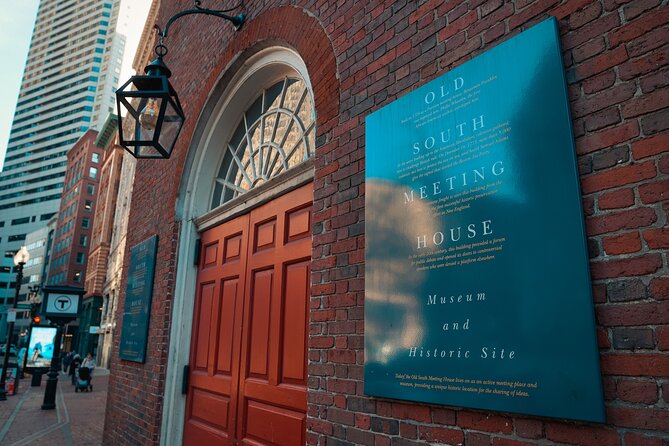
At Old South Meeting House, focus on understanding the meeting hall itself and how that layout supported public discussion. The reviews highlight that it’s a large church with parishioner boxes and that it served as a key meeting location for discussion leading to acts of defiance like the Boston Tea Party. Spend extra time with the displays that connect the building’s purpose to the political events of the era.
At Old State House, slow down for the artifacts and visuals tied to events leading to the Revolutionary War. The State House museum is described as having many artifacts and as packed with historical facts, with a strong emphasis on the Revolution-era timeline. This stop is where you connect the dots from what people were saying and organizing to what happened when the conflict reached government power, including the Boston Massacre.
If you’re the “I want the whole story but I also want to stay sane” type, here’s a simple approach. Read enough on each major display to understand the point, then pick one or two sections to go deeper on. That keeps you from getting lost in details while still getting real substance.
Also, if you’re sensitive to heat, know that reviews call out air conditioning at both locations. That means you can plan to enjoy the exhibits even on hot days without feeling wrecked halfway through.
Who should book this, and who should plan an alternate route

This experience is ideal if you love American history and want the Revolution explained in an easy-to-follow way. It’s also great if you’re doing the Freedom Trail and want a compact add-on that gives extra context. One review specifically mentions pairing it with a Freedom Trail day, which is exactly the kind of match that works well.
It’s also a smart pick for families who like history but don’t want a long, complicated program. The museums are described as easy to navigate, and the sites are close together, so even a younger group can move through without constant regrouping.
One group to plan carefully: accessibility needs. Old South Meeting House is accessible, but Old State House is not currently accessible, even though plans are mentioned to improve access in the future. If someone in your party needs step-free routes, prioritize Old South and treat Old State House as optional based on your mobility needs.
Service animals are allowed, which is a comfort for many visitors.
Book it or skip it: my take for first timers in Boston
If you’re short on time and want a high-impact history stop, I think you should book this. Two major Revolution-linked buildings, two-block convenience, and museum exhibits that are described as easy to navigate and full of historical facts, plus the chance to see artifacts connected to key events. That combination is hard to beat for the time.
Skip it only if you have zero interest in American Revolution-era details and prefer lighter attractions. This isn’t a restaurant or a view-point kind of stop. It’s about context, artifacts, and how public meetings and government power shaped the break from England.
If you’re planning ahead, note that this is commonly booked about 32 days in advance on average. If you’re traveling in peak periods or want a specific time window, it’s worth securing your spot early so you’re not guessing on the day.
FAQ
What is the cost per person for Boston’s Old State House and Old South Meeting House Museums?
The price is listed as $15.00 per person.
How long does the experience take?
The duration is listed as approximately 30 minutes to 2 hours.
Where in Boston are these museums located?
Both are in the heart of downtown Boston, and Old South Meeting House is noted as being about two blocks from the Old State House.
What are the opening hours for this experience?
For January 1, 2026 through June 30, 2026, it runs daily from 10:00 AM to 5:00 PM.
Is the visit guided or self guided?
The experience is described as self guided through the Old State House and Old South Meeting House.
Are tickets mobile?
Yes, this experience uses a mobile ticket.
Is admission included for both sites?
Admission is shown as free for both the Old South Meeting House and the Old State House within this experience.
Is Old State House accessible?
Old State House is not currently accessible, while Old South Meeting House is accessible.
Can I cancel for a full refund?
Yes. You can cancel up to 24 hours in advance for a full refund, and free cancellation is available.
Are service animals allowed?
Yes, service animals are allowed.
If you want, tell me your travel dates and whether you’re doing the Freedom Trail in one day, and I’ll help you pick a realistic time plan for both stops.
More Tour Reviews in Boston






Keep Going in Boston

More Revolution in Boston





More around Boston, freshly written up
- The Boston Bash Scavenger Hunt★ 4.5 · 3 reviews
- Self-Guided Audio Tour of Boston North End★ 4.5 · 3 reviews
- Self-Guided Boston Christmas Tour★ 5.0 · 3 reviews
- Self Guided “The North End Pizza, Cannoli and Picnic” Solo Walking Tour★ 5.0 · 3 reviews
- Cambridge: Haunted Charles River Cruise★ 4.3 · 3 reviews
- Boston: Official Freedom Trail® Lantern Tour★ 4.7 · 3 reviews
Revolutionary Boston History Tours, compared.
 ★ 4.5Boston Tea Party Ships and Museum AdmissionFrom $352,512 reviews
 ★ 5.0The Full Revolutionary Story Epic Small Group Boston Walking TourFrom $552,356 reviews
 ★ 4.8Boston Tea Party Ships and Museum Interactive TourFrom $351,926 reviews
 ★ 4.9Boston’s Freedom Trail: A Revolutionary Walking TourFrom $311,748 reviews
★ 5.0Boston’s Freedom Trail: A Revolutionary Walking TourFrom $311,343 reviews
 ★ 5.0Entire Freedom Trail Walking Tour: Includes Bunker Hill and USS ConstitutionFrom $79732 reviews
 ★ 5.0Boston’s Revolutionary and Drunken Past with Ye Olde Tavern ToursFrom $91195 reviews
 ★ 4.8Boston History & Highlights Tour: From Revolution to TodayFrom $44178 reviews
Also filed under