2 Hour Boston Historical and Heritage Walking Tour

REVIEW · WALKING TOURS

2 Hour Boston Historical and Heritage Walking Tour

4.5 · 70 reviews 2 hours (approx.) From $5 Operated by Boston Free Walking Tours · Bookable on Viator
Book on Viator →

Boston history, told on foot. I loved the way Stephen turns Boston Common into a living timeline, and I also liked the way the route builds toward Faneuil Hall with great photo moments. One thing to consider, the tour can feel information-heavy and a bit fast when the group moves through busy streets.

At just $5, you are really paying for a guide who can connect monuments to the people behind them. The group stays small (up to 24), you get a mobile ticket, and the whole experience is in English, so it is easy to hop in and follow along.

You will cover a lot in about two hours, mostly outdoors and mostly standing still for quick explanations. Good shoes matter, and if weather turns, the tour notes that good weather is required, with an option to switch dates or get a refund.

Key highlights to look for

2 Hour Boston Historical and Heritage Walking Tour - Key highlights to look for

  • Boston Common through the ages, including cattle on the 45 acres and public gatherings tied to major events
  • Park Street Church abolitionist stories, plus the debut connection to My Country, ’Tis of Thee
  • A focused Civil War stop at the Robert Gould Shaw and 54th Regiment Memorial
  • Revolution route moments, including the Boston Massacre site and the Tea Party action on Milk Street
  • Culture and publishing stops, from the Old Corner Bookstore to Boston Latin School and its nearby donkey
  • Smart end point for exploring, finishing by City Hall near classic North End gateways

Price and time: why this walk is such good value

2 Hour Boston Historical and Heritage Walking Tour - Price and time: why this walk is such good value
Let’s talk money first. At $5 per person, this tour is a rare deal in a city where guided walks can cost a lot more. What helps the value even more is that the stops are mostly outside, and the tour notes that admission is free for the listed sights. So your payment is basically about one thing: a guide who can narrate Boston in a way that sticks.

Time wise, it is scheduled for about 2 hours and set up as a walk that is easy to fit into a day. Still, several experiences reported timing running longer than the plan. In practice, you should treat the 2-hour label as a target, not a hard stop. If you have a later reservation with strict timing, plan a cushion.

You are also walking at city speed. Some parts are quick in and out, with short photo windows. If you want long pauses for museum-style looking, this is not that format. Think “high quality highlights,” not “slow wandering.”

Meeting point and the overall route from Boston Common to City Hall

2 Hour Boston Historical and Heritage Walking Tour - Meeting point and the overall route from Boston Common to City Hall
The tour starts at Boston Common, at the Boston Common Tablet at 1634 Freedom Trail, and ends at the James Michael Curley statues at Congress Street and North Street. It also notes the one-mile tour ends directly across from Faneuil Hall, so you are finishing right where you can keep exploring after the last story lands.

Why I like this layout: you get a natural “day core” route. Boston Common and the Freedom Trail area are the backbone of so much of the city’s main story. Then you progress into the civic and commercial heart, finishing where snacks, views, and more walking options are all close.

You will also be near public transportation, and service animals are allowed. If you are coming from another neighborhood, you should have an easier time getting there than with tours that start in a far-off area.

Finally, group size matters here. With a maximum of 24, it is not a huge crush. You will be able to ask questions at stops, and the guide can usually keep an eye on the group.

Boston Common: the oldest park and the strangest stories

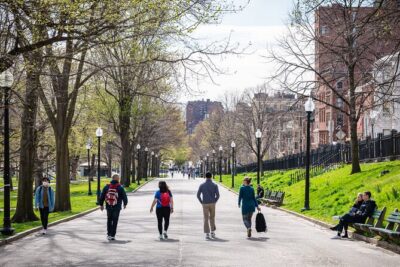
You start at Boston Common, and the tour uses it like a headline page for Boston. This is the oldest public park in America, and you get a fast dose of why that matters. The key idea you take away is that Boston Common is not just scenery, it is where the city’s decisions and conflicts played out.

You hear about military drills in colonial times and later civil rights rallies, which reframes the park. It becomes a stage that changes costumes over the centuries. The tour also mentions everyday life, including cattle pastured on its 45 acres, plus public events like hangings and duels. That mix is jarring, but that is the point. History here is not polite. It is real, messy, and public.

Photo tip: if the weather is clear, Boston Common gives you lots of backgrounds without having to move far. Keep your camera ready when you hear the stories, because the “wow” moments often tie to what you are physically looking at.

Drawback to plan for: Boston is windy and weather can swing quickly. Even in mild seasons, you might get chilly standing at the edges while the guide explains. Dress in layers and be ready for wind at open spaces.

Park Street Church and abolitionist Boston, including the hymn connection

Next is Park Street Church, and this stop has a strong emotional core. The tour emphasizes the church’s contributions to the abolitionist movement and missionary activity. You are not just hearing dates. You are hearing what people believed and what they risked.

One detail I think you will appreciate is the connection to Samuel Francis Smith and the debut of My Country, ’Tis of Thee on July 4, 1831. That turns a famous American song into something more specific and grounded in place, rather than a distant classroom fact.

What makes this stop work well on a walking tour is that it gives you a clear shift from parks and civic space into organized activism. You start to see how Boston’s public spaces connected to real action.

If you are not sure you like “church history,” this is still worth it. The story here is about movement, advocacy, and identity. It also sets up later stops about courage and who gets remembered.

Robert Gould Shaw and the 54th Regiment Memorial: bravery with a clear focus

This stop is short but powerful: the Robert Gould Shaw and the 54th Regiment Memorial for the 54th Massachusetts Infantry Regiment. The tour highlights the regiment as one of the first African American units in the Civil War, and it centers the commander alongside the broader story.

I like that the tour keeps the focus tight. In many city walks, Civil War memorials get rushed. Here, you get a clear reminder that monuments are not just about a battle. They are about recognition, sacrifice, and who history chose to honor.

Photo tip: aim for a straight-on shot that shows the memorial shape, then step slightly aside for a second angle. Some statues and memorials can look flatter from one side, and small repositioning fixes it.

Consideration: because this is a quick stop, if you want a long read of inscriptions, bring your phone notes ready. Take a couple of photos, then capture any text you might want to look up later.

Massachusetts State House: the golden dome plus the human stories behind it

From the Common area, you move toward the Massachusetts State House, with its iconic golden dome. This stop is about how Boston built its civic identity and how architecture becomes a statement of power.

You also get character-based history at the State House. The tour mentions statues including General Joseph Hooker, and Mary Dyer, who was hanged for her Quaker beliefs. That detail matters because it shows you a side of early Boston that was strict, and sometimes brutal, about religious nonconformity.

This is one of those moments where the guide’s storytelling pace makes a difference. When it goes well, you end up remembering the names because the stories give them context.

If you are sensitive to crowds, this is also a practical consideration. State House streets can get noisy and busy. Expect to hear street noise, and if you have trouble hearing, keep close to the guide.

Private Library of the Brahmins: a “you might miss this” intellectual clue

2 Hour Boston Historical and Heritage Walking Tour - Private Library of the Brahmins: a “you might miss this” intellectual clue
The tour includes a stop about the private library of the Brahmins, described as a hidden gem with rare and valuable books. Even though this kind of place is not always fully accessible in the way a public museum is, the value comes from what you learn: Boston’s elite literary and intellectual circles played a bigger role than most guidebooks spell out.

This is the kind of stop that works for people who like atmosphere and institutions, not just famous landmarks. It gives you a lens for understanding why Boston debates and ideas spread the way they did.

Practical note: because the tour wording suggests a “hidden gem,” you should expect it to be a brief look and a narrative explanation, not time inside for everyone. If you want to go deeper later, write down the name you hear and research it afterward.

West End and Scollay Square: entertainment districts, with a Kennedy wink

Next comes West End and the history of Scollay Square, described as a bustling entertainment district with theaters and vaudeville. The tour adds color about colorful characters and how the neighborhood worked as an entertainment magnet.

Then it mentions a Love Nest of the Kennedys, with a peek into romantic history tied to the family. That part is less about politics and more about pop-culture Boston, the city as seen through celebrity lore.

This stop is a nice reset if you have been sitting with heavy themes like slavery and civil war. It reminds you that Boston was also nightlife, stage lights, and crowd energy.

If you care about photos: this area can be lively. The drawback is that stopping for pictures can be hard when street traffic and tour groups also want a moment. Still, the stories make the place feel more specific than a walk-by.

Old State House and the road to rebellion: Declaration of Independence on the street

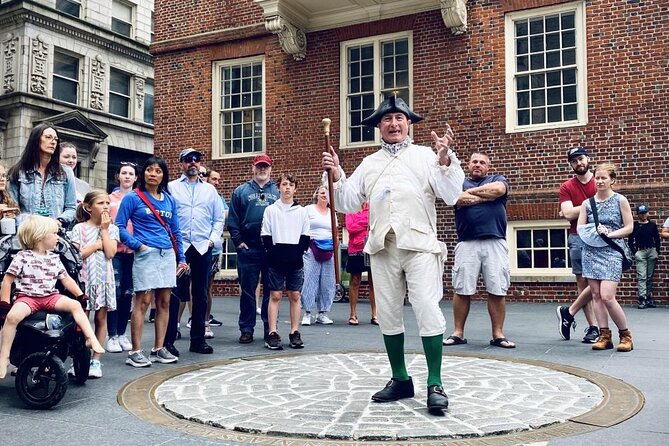
Then you move to the Old State House, framed as a revolutionary landmark with deep context. The tour ties it to key events, including the reading of a copy of the Declaration of Independence to citizens of Boston in 1776.

One of the most memorable parts here is a practical survival story for a landmark. When the Old State House fell into disrepair at the end of the 19th century, Chicago offered to buy it. Boston people came to the rescue and salvaged the site, and it was meticulously restored.

That kind of detail matters because it shows you history is not only past events. It is also later decisions about what to preserve and what to let disappear.

Drawback to keep in mind: this portion of the walk is often on busier sidewalks. If you want extra space for photos, you will likely need to step just slightly aside from the main cluster.

Boston Massacre site: the moment that inflamed the crowd

A few stops later, you reach the Boston Massacre site. The tour describes it as a pivotal moment leading up to the American Revolution, focusing on the confrontation between British soldiers and American colonists and the outrage it sparked.

Even if you know the basic story, listening to it on the actual spot helps because you start imagining how quickly rumors and anger could spread in a tight city area. The guide’s job is to connect what you see with what people felt.

Timing consideration: this is a short stop, so if you want to unpack it later, take a photo of any nearby interpretive sign, then look it up.

Tea Party on Milk Street: December 16, 1773 and the disguise plan

The tour includes the Tea Party moment connected to December 16, 1773. The story centers on about 5,000 citizens gathering during the tea crisis, agreeing to prevent the landing of British tea ships. Then a group disguised as Mohawk Indians leads a mob down Milk Street to Griffin’s Wharf for the action.

This is one of those segments that tends to feel dramatic because it connects crowd size, coordinated plans, and real risk. It also helps you understand how the Revolution was not only battles, but organized civil resistance.

Practical tip: pay attention to street names the guide mentions here. Streets you walk today often match the routes used then. Even if you are not planning a full Freedom Trail day, it gives you a mental map.

Boston Irish Famine Memorial and the immigrant story Boston still carries

As the tour moves away from purely revolutionary scenes, it adds the Boston Irish Famine Memorial. The focus is on Irish immigrants who fled the Great Famine of 1845 to 1852 and found refuge in Boston. The tour also notes that they became the largest ethnic group by 1850.

A useful takeaway from this stop is the way it frames the memorial as not only Irish. It is also a tribute to immigrant groups who came to the city. That broadens the story. Boston becomes a city shaped by arrivals and survival, not just by founding myths.

Photo and timing: memorial stops are usually quick, but the mood is quieter. Take a second when you can, even if the group is moving.

Old Corner Bookstore: from apothecary to author meeting place

Next is Old Corner Bookstore, described as built as a residence and apothecary in 1718, then used as a bookstore in 1828. It was home to Ticknor and Fields publishers for three decades.

What makes this stop especially fun is the list of author names you hear associated with the place: Henry Wadsworth Longfellow, Nathaniel Hawthorne, Oliver Wendell Holmes Sr., and Ralph Waldo Emerson.

This is a strong example of how a walking tour can change your day. You start seeing Boston as a city of publishing and debate, not just monuments.

If you are a book person, you will probably linger mentally even after the stop ends. It is also an excellent “bridge” from historical politics into culture, ideas, and everyday life.

Boston Latin School area: first public school and a friendly donkey moment

The tour heads toward Boston Latin School, tied to School Street named for the site of the first public school in the United States. The guide mentions the school street area passing by King’s Chapel, Old City Hall, and the Parker House.

Then there is the donkey, described as a beloved landmark waiting patiently on School Street. That is the kind of small detail that breaks the seriousness just enough to keep the walk fun.

I find this stop valuable because it reminds you Boston’s story includes education and civic institutions, not only protests and wars.

Hearing note: the walk here is often near other attractions and tour groups, so noise can rise. Keep close to the guide if you want the best listening.

Faneuil Hall Marketplace: grasshopper weathervane and the idea of liberty

You end the main landmark loop at Faneuil Hall Marketplace, often called the Cradle of Liberty. The tour mentions its grasshopper weathervane, believed to be modeled after London’s Royal Exchange, which is a great cross-Atlantic detail.

Then it brings in a complicated origin story. It notes Faneuil Hall was gifted to Boston by Peter Faneuil, described as a slave trader. That is not an easy fact, but it is an important one. Boston’s “liberty” story includes people and power that do not match the tidy version.

The tour also ties Faneuil Hall to the Ancient and Honorable Artillery Company of Massachusetts, described as the oldest military body in the Western Hemisphere, with a charter in 1837. If you like how institutions evolve, this is where the idea of “public gatherings” meets long-term organizations.

Photo tip: the weathervane and the hall facade are great, and the energy around Faneuil Hall makes your final photos look like a real vacation moment.

Boston City Hall finish: Curley statues and where to go next

The tour concludes by Boston City Hall, near two statues of James Michael Curley, four-time mayor, governor, and congressman, described as a flamboyant big-city boss. It positions Curley as the rascal king of politics for fifty years.

If that feels like a shift away from early America, that shift is intentional. It reminds you Boston history is not frozen in the 1770s. Local politics and personality shape the city as much as revolutions do.

Right nearby, the tour also notes the Union Oyster House, and the Bell in Hand tavern, described as the oldest pub in town, plus Hanover Street as a gateway to the North End. That makes the ending practical. Once you step out of the tour mindset, you still have options.

The guide factor: Stephen’s style, pace, and how to make it work

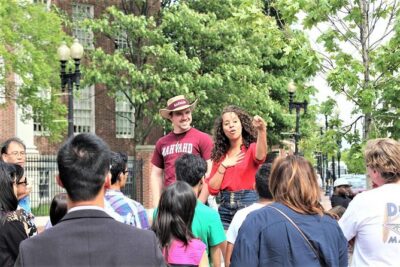
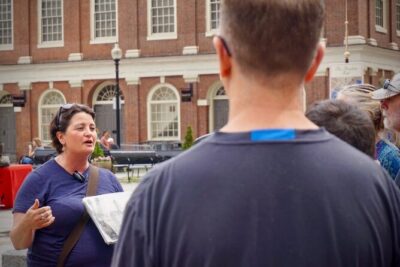
Across the experiences, the guide gets consistently high praise. People mention Stephen as a strong storyteller, with lots of detail and lots of answers when questions come up. Another recurring theme: he can go fast, and in noisy areas, it can be harder to hear.

Here’s the practical way to handle that if you book:

  • Arrive a few minutes early so you start positioned near the front.
  • If you feel you are falling behind, ask a question right away. It often resets the pace and helps you catch the narrative thread.
  • Wear hearing-friendly layers, because wind and street noise add up.
  • If you are concerned about understanding, consider booking if you are comfortable with fast spoken English. Several comments specifically flagged that it can be challenging for non native speakers.

Also, one piece of good news: the guide has taken steps to improve the experience after feedback, including using a voice amplifier. That tends to help a lot, especially near intersections.

One more consideration: the “tour was scheduled for 2 hours” label sometimes stretches. If the group is slow, weather changes, or breaks are needed, the walk can run longer. The upside is you are usually getting more story, not less. The downside is you need a little breathing room in your schedule.

Who should book this, and who should pick a different tour?

This one is a great fit if you:

  • Like history that includes people, not just dates
  • Want a fast way to connect Boston Common, the Revolution sites, and the civic core
  • Enjoy questions during a walk, and you do not mind hearing a lot in a short span
  • Want value at a very low price point, with mostly outdoor stops

You might want to choose something else if you:

  • Need a slow, relaxed pace with lots of time to sit and read
  • Get frustrated by street noise and crowds
  • Have strict timing constraints later the same day
  • Prefer a lighter overview rather than a very story-dense route

Should you book the Boston Historical and Heritage Walking Tour?

I think you should book it if you want a guided “Boston map” built from real stories, not just a checkbox list of monuments. At $5, you are buying a guide-led narrative through Boston Common, abolitionist Park Street Church, Civil War commemoration at the Shaw memorial, and the Revolution route all the way to Faneuil Hall.

My one caution is pacing. If you are sensitive to fast delivery, start close to the guide, and plan extra time. If you can handle that, this is an excellent way to make the city feel personal quickly.

FAQ

How long is the walking tour?

The tour is scheduled for about 2 hours.

How much does the tour cost?

The price is $5.00 per person.

What language is the tour offered in?

The tour is offered in English.

Where does the tour start and end?

It starts at Boston Common Tablet, 1634 Freedom Trl, Boston, MA 02108. It ends at the James Michael Curley statues at Congress St @ North St, Boston, MA 02108, directly across the street from Faneuil Hall.

What is included in the tour?

It includes an in-person guide speaking English.

Do you need admission tickets for the stops?

Admission is listed as free for the tour stops.

Is the tour affected by weather?

Yes. The experience requires good weather. If it is canceled due to poor weather, you are offered a different date or a full refund.

Is cancellation free?

Free cancellation is available. You can cancel up to 24 hours in advance for a full refund.

Is the tour group size limited?

Yes, the tour has a maximum of 24 travelers.