REVIEW · SALEM WITCH TRIALS AND HISTORY TOURS
Best Salem Witch Trials Historical Walking Tour
Salem’s witch trials feel uncomfortably personal. This 90-minute Salem Witch Trials Historical Walking Tour keeps you close to the key places that fueled 1692 fear, even though Salem has changed a lot. You’ll get the story as you walk, not as a slideshow, with a guide who helps you spot what still matters today.
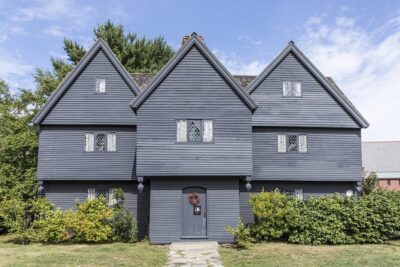
I particularly love two things: the Salem Witch Trials Memorial and how it puts real names on the tragedy, and the Witch House stop that shows the only remaining structure tied directly to the 1692 trials. The memorial gives you names, death details, and the symbolism behind the design, then the route keeps moving through the men and systems that turned accusations into arrests and executions.
One drawback to plan around: most of the original buildings from 1692 are gone, so several stops are modern streets and lots with pictures of what used to be there. Also, this is about one mile of walking, and it includes standing and uneven sidewalks, cobblestones, and stairs.
Key points before you book

- Memorial-first start so you begin with names, not just myths
- Witch House credibility since it is the only remaining 1692-tied structure
- Court and jail sites explained through downtown locations you can actually reach
- Order can shift as the guide makes time for the most important stops
- Quick, workable pace (about one mile in 90 minutes) with frequent viewing breaks
- Guide style matters, so come ready with questions
More of 1692, told properly
Why this Salem Witch Trials walking tour works

The Salem Witch Trials are one of those topics that can turn into spooky theme park noise fast. This tour does something better: it treats 1692 like a real town crisis, with people making decisions, rumors spreading, and officials using law in cruel ways. You walk through the downtown area while your guide connects each location to the larger pattern.
What makes it practical is the pacing. It is about 90 minutes and roughly one mile, with time built in to stop at points of interest, not just rush from curb to curb. The group size is capped at 40, so you are not stuck shoulder-to-shoulder in a huge crowd for the whole outing.
And yes, the “haunted Salem” vibe is there, but it is grounded in places. A lot of Salem’s 1692 buildings are long gone, yet the guide still helps you picture where things stood, what buildings served what roles, and why certain sites became magnets for fear.
Price and value: where $30 fits

At $30 per person for a 90-minute guided walk, you are paying for three things: time saved, interpretation, and a focused route. Salem is full of witch-themed tours, and it can be tempting to DIY. But if you do that, you often end up piecing together the same half-true stories again and again.
This one is designed to reduce your research stress. You start at the Salem Historical Tours Office at 8 Central St, then your guide leads you through downtown stop by stop, including locations tied to the trials and key figures. Even when buildings are missing, the guide helps you make sense of what is left behind.
It also helps that some parts of the tour are marked as free admission, like the memorial and several viewing stops. Other stops are listed as not included, such as the Rockafellas Restaurant stop and sites like the Witch House, so you may add small extra costs depending on what you choose to enter.
The real value is that you get a coherent story arc in a short time. In Salem, that matters. You can always spend more time later, but a strong first pass can save you from wandering for hours with no clear thread.
Meeting point, timing, and what to wear
Check in at Salem Historical Tours Office, 8 Central St, Salem. Plan to arrive about 15 minutes early, because tours depart at 10 am, 1 pm, and 4 pm, and you want your group to be settled before the walking starts.
Bring layers. The tour runs in all weather, and Salem sidewalks can feel harsher than you expect, especially when it is cold or windy. Also, skip heavy footwear that takes forever to break in, because this route involves standing, uneven surfaces, and occasional stairs.
Accessibility is a real consideration here. The tour covers about one mile, and participants must be able to finish within 90 minutes while handling frequent stops for viewing and information. Sidewalks can be narrow and uneven, with bricks, cobblestones, and stairs.
Finally, if you are visiting in October, plan for crowds and traffic. Parking can be tough, and it can get worse near Halloween. Give yourself extra buffer time, even if your GPS insists you have plenty.
Stop-by-stop: what you’ll see and why it matters

Your tour begins with a quick framing at the Salem Historical Tours starting point. The guide sets up what you should pay attention to: the demographics, competing theories people used, and the personal stories behind the accusations. This matters because 1692 was not a single ghost story, it was a social crisis where fear and authority met in public.
From there, the tour moves into the heart of Salem’s surviving trial-linked reminders.
More of Salem on foot
The Salem Witch Trials Memorial: names, dates, and symbolism
This is one of the strongest stops because it forces you to treat the victims as people, not symbols. The Salem Witch Trials Memorial, dedicated in 1992, includes benches with the names of the 20 innocent victims, how they died, and the date. Your guide explains the symbolism, which helps you understand why the memorial looks the way it does and what the layout is meant to communicate.
Why I think this stop is so valuable for most visitors is simple. Once you have the names in your head, the later stories stop feeling abstract. You are more likely to notice the pattern behind the accusations, the roles officials played, and the speed at which lives were destroyed.
If you care about details, this is the place to ask questions. The memorial is structured for learning, so it is easier to talk through the specific names and what they represent than it is on a busy street corner.
Rockafellas Restaurant: when a church and meeting house become a restaurant
Next up is Rockafellas Restaurant. This site is tied to the First Church of Salem and the city meeting house in 1692, which means it sat right in the civic center of town life during the trials. Today it is a popular eatery, but the location still matters because it shows how public worship and public decision-making shared the same physical space.
Even if you do not stop for a meal, you get a useful contrast. You stand in the center of modern Salem, then your guide connects the dots back to the earlier community role this building played.
A practical tip: food is not included. If you want to snack later, plan to return after the tour.
Joshua Ward House (now the Merchant Hotel): George Corwin’s role
The tour then reaches the Joshua Ward House, now the Merchant Hotel. This is where George Corwin’s house once stood. Corwin was the High Sheriff of Essex County in 1692, and your guide explains his role in signing arrest and execution warrants for innocent people.
The story does not only stay at the level of paperwork. You also hear about how Corwin was involved with property taken during the trials, and the darker claim that he tortured some people at his home. That combination, official authority plus personal cruelty, is part of what made 1692 so lethal.
This is also a good stop for pacing. It is short, so you are not trapped in a long explanation. You get enough context to carry forward as the route moves into the “how did the system work” details.
The Witch House at Salem: the only remaining direct structure
If you only remember one 1692 location from this walk, make it the Witch House at Salem. It is described as the only remaining Salem structure with direct ties to the 1692 witch trials. Your guide links it to Judge Jonathan Corwin, and explains how Judge Corwin met with Judge Hathorne in this house to discuss who could be called a witch.
The Witch House dates back to the 1660s. That time gap is the point. You are not just looking at a memorial plaque. You are looking at a surviving building that helps anchor the story in real bricks and boards.
This is also where you can feel the difference between myth and documentation. When the setting is still here, it becomes much harder to blur the facts into campfire storytelling.
Salem YMCA: Betty Parris and how fear spread
Next, you visit the Salem YMCA on Sewall Street, named for judge Stephen Sewall of the Witchcraft Court. This is tied to a key personal story: nine-year-old Betty Parris was moved here in July of 1692.
Your guide explains who Betty was, the connection to Rev. Parris, and the role Betty and her cousin played in sparking the witchcraft hysteria. That shift in focus, from officials to a young person’s experience in the middle of town panic, helps you see that fear did not stay in the courtrooms.
This is a stop that can feel emotionally heavy, so it is worth paying attention to how the guide frames it. The point is context, not cheap shock.
Turner’s Seafood at Lyceum Hall: the land behind Bridget Bishop
Another tightly connected site is Turner’s Seafood at Lyceum Hall. The building sits on land once owned by Bridget Bishop and her husband Edward. Your guide tells her story, including the pace of her case: it took eight days from her arrest to her trial and execution.
That time window is one of the most chilling details in all of 1692. When you hear it standing in a place that looks like today’s Salem life, it hits harder. It also clarifies why so many families later felt trapped by a system that did not slow down for due process.
Witch Dungeon Museum: jails, not witch stories
At one point, the route includes the Witch Dungeon Museum. This stop is not tied directly to the 1692 witchcraft trials, but it helps explain how jailing worked. Your guide talks about small jail cells, the kind of confinement people were facing, and the idea that prisoners had to pay for their own jail time.
There is also a photo opportunity in the pillories, also called stocks. I like this type of stop when it stays informational, because it helps you understand what court decisions looked like after they landed.
Just know it is an optional add in the sense that it is not a “this is where the 1692 jail stood” claim. It is more about how punishment systems operated.
Bewitched Statue of Elizabeth Montgomery: pop culture on trial
Then you reach the Bewitched Statue of Elizabeth Montgomery, where you can take a picture with Samantha Stevens. Your guide also points out the episodes shot in Salem and whose land the statue sits on, which creates a bit of irony.
I think this stop works as a breather in the middle of a heavy story. It also makes a larger point about how towns process their past, sometimes by turning it into film sets and statues.
If you hate pop culture interruptions, you may still enjoy it as a conversation starter. It is not the core history, but it puts the tourist spotlight where it belongs, on how Salem sells and remembers.
Salem Masonic Building (Essex Lodge) and the court of Oyer and Terminer
The walk continues to the Salem Masonic Building, Essex Lodge. Here, the tour points out that the Witchcraft Court, called the court of Oyer and Terminer, was located on Washington Street in front of the building. Most of the trials were held in this location, with additional trials in January of 1693.
Your guide explains decisions and describes a grim twist where one accused was declared innocent by the jury but the judges nullified the decision. That is the key mechanism behind the hysteria. It was not just fear. It was fear backed by the power to overrule.
Even if you do not know anything before you arrive, this stop gives you a clear picture of how verdicts could be manipulated.
50 St Peter St: where the witchcraft jail used to be
Another important stop is 50 St Peter St. The Witchcraft Jail is gone, but your guide ties the location to the jail system used during the trials, including the idea that it was one of the jails in the greater Boston area. You hear names that were jailed here, including Giles Corey, the man crushed during an interrogation.
This is one of those stops where you can feel the limits of today’s city. Buildings are gone. What remains is the spot and the names. That is why the guide’s explanation matters.
Ending where you started: what to do after
The tour ends where it began, back in the downtown area, so you are not stuck at some far edge of Salem. Your guide can point you to where you want to go next.
If you want to keep the story going, build in extra time after the walk. You might want to revisit one location you found especially impactful, or browse the memorial area and adjacent streets without the group pace.
How the guide shapes the whole experience

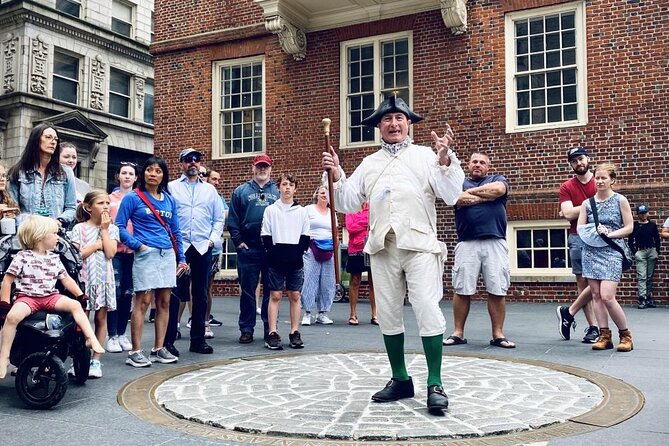
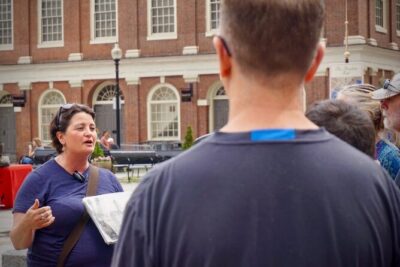
This tour lives or dies by the guide. The format is simple: your guide holds a recognizable sign, gathers you, then leads the group from stop to stop. There is flexibility too, because the guide may go to as many of the locations as possible, and the order may not match the list exactly.
That flexibility is useful, but it also explains why some visitors feel they did not see certain places. With limited time and about one mile of walking, the tour can only cover so much, especially if the group moves slowly at an important site.
One positive pattern I paid attention to in the guidance style is engagement. In the reviews, one guide named Bob stands out as especially good at bringing the 1600s to life, with fun delivery that still keeps the story grounded. If your guide is that type, you are likely to feel that the walk moves quickly even when the content is heavy.
A practical “you can control this” tip: ask questions early. If you want more focus on a specific theme, like how the court system overpowered jury decisions, say so when you are still near the start.
Who this Salem Witch Trials walking tour is best for

This is a strong fit if you want a guided Salem Witch Trials walking tour without spending half a day figuring out where to go. It is also a good option if you like the idea of learning through real locations rather than only museum displays.
Families can do it, but plan around walking. Children must be accompanied by an adult, and the group covers about one mile with stairs, uneven ground, and frequent stops for information.
History lovers will like the way the guide connects civic sites, judge-linked locations, and jail-related details. It is not a fantasy-themed sprint through spooky streets. The tone is about fear, authority, and the way ordinary people got pulled into a disaster.
Should you book this tour, or keep it DIY

I think this is worth booking if you want your Salem Witch Trials overview to feel organized and meaningful. The $30 price gets you a guide, a tight route, and context at the exact sites where you can actually stand and look around.
It is not for you if you expect every 1692 structure to be visible. Most original buildings are gone, so you will see locations, memorials, modern buildings sitting on old ground, and the one standout surviving structure: the Witch House. Also, if you struggle with standing for long stretches, uneven sidewalks, stairs, or mobility constraints, you may find the one-mile walk tough.
My bottom line: book this if you want the fastest way to understand 1692 from inside downtown Salem. Skip it if you already know the story and you just want a light stroll.
FAQ

How long is the Best Salem Witch Trials Historical Walking Tour?
The tour lasts about 90 minutes.
Where do I check in for the tour?
Check in at Salem Historical Tours Office at 8 Central Street, Salem, MA 01970. Plan to arrive 15 minutes early.
What time does the tour depart?
Tours depart at 10 am, 1 pm, and 4 pm.
How far will I walk?
The tour is about one mile long.
Is the tour in English?
Yes, it is offered in English.
Are service animals allowed, and what about restrooms or parking?
Service animals are allowed. Hotel pick-up and drop-off are not included, parking is not included, and there are no public restrooms provided.
More Tours in Salem
More Tour Reviews in Salem
Salem, Still More to See
More around Salem, freshly written up
- Magick Broom Costume Photography – Green Screen Technology★ 5.0 · 11 reviews
- Salem: Witch Trial History and Salem Haunts Walking Tour★ 4.5 · 41 reviews
- Salem 101 General History Tour★ 4.3 · 41 reviews
- Spirits, Sinners & Scandals Tour★ 4.5 · 41 reviews
- Salem: Witch Costume Photo Studio Experience★ 4.9 · 43 reviews
- Salem and The Witch Trials★ 5.0 · 46 reviews
Salem Witch Trials and History Tours, compared.
★ 5.0History and Hauntings of Salem Guided Walking TourFrom $3614,564 reviews
★ 4.5Salem’s Best Ghost TourFrom $304,186 reviews

★ 5.0Salem Voodoo, Vampires, and Ghosts Guided Walking Tour1,931 reviews
★ 5.0Bewitched Walking Tour of SalemFrom $351,895 reviews
★ 5.0Satanic Salem Walking TourFrom $301,635 reviews
★ 5.0Mysteries and Murders of Salem Guided Night-Time Walking TourFrom $361,488 reviews
★ 4.5The Salem Witch WalkFrom $251,301 reviews
★ 5.0Wicked Awesome Tours: Witch Trial History and Salem Haunts!From $291,032 reviews