
REVIEW · SALEM WITCH TRIALS AND HISTORY TOURS
Salem and The Witch Trials
Salem hits differently when you walk it. This 1 hour 15 guided stroll connects major sites from the 1692 Salem witch trials to today, with a tone that stays empathetic and grounded. Led by a licensed local guide (Jobian is a standout name guests mention), the tour keeps moving while explaining what happened and why it mattered.
I also love the tight format: five stops, each about 10 to 20 minutes, so you get the essentials without getting stuck in long museum rooms. And since each stop notes admission ticket free, you avoid surprise entry fees and can focus on learning.
One consideration: the meeting point can be a little unclear. The start listed as 158 Essex St does not match what some people expect on arrival, so give yourself extra time to find the group.
Key highlights you will notice fast

- Fact-focused storytelling that explains the real sequence of events, not just spooky vibes
- A respectful tone that keeps the victims and community impact front and center
- Five meaningful stops that you can actually revisit later on your own
- Free admissions at each featured site, so your $29 goes toward the guide experience
- Small-group feel (maximum 40) that helps the guide answer questions
More of 1692, told properly
Salem and the Witch Trials, why these places still matter

Salem is famous for witch stories. This tour uses that fame to do something more useful: it points you to the physical locations where the trials took shape and where the community lived with the consequences.
A big part of what you are learning is not just the headline events. You are also getting the context around how a tense moment can spread through a town, especially when fear, religion, and local power collide. The best moments on this kind of walk are the ones where the guide turns a name you have heard into a real person with a real life.
What makes this one work is the balance. It stays on history and context, but it also reads like a human lesson, not a textbook lecture. Guests repeatedly highlight the empathy in the delivery, which matters because the material is heavy.
Price and logistics: $29 for 1 hour 15 of guidance
At $29 per person for about 1 hour 15, you are paying mainly for the guide and the routing. That can sound straightforward, but it is a good deal in Salem where a lot of witch-related experiences either feel overly theatrical or charge extra to get inside places.
Here is why this price often works well for you:
- You get a licensed local guide, and the tour is structured so the facts build stop by stop.
- Each listed stop shows admission ticket free, so your money stays with the experience, not entry costs.
- The tour language is English, which keeps it accessible if you are traveling in the US and want your explanations to land clearly.
Group size is capped at 40. That is not a tiny private tour, but it usually feels manageable, and it gives the guide space to interact without losing the flow.
You also get a mobile ticket, so you are not scrambling for paper once you get to Salem. If you like to travel light, that alone is worth something.
Getting started at 158 Essex St: find the group, then relax
Your start is at 158 Essex St, Salem, MA 01970. The tour ends back at the same meeting point.
Here is the practical tip: arrive a little early and take a minute to orient yourself on the street. One guest review notes the meeting place address can be confusing, even though it is listed. Salem has lots of narrow lanes and close building numbers, so a quick early check can save frustration later.
If you prefer public transportation, you should be fine since it is listed as near public transportation. Service animals are allowed, and most travelers can participate, so you should not feel like you need special training to join.
Stop 1: Salem Witch Trials Memorial, a place to remember first

You begin at the Salem Witch Trials Memorial, described as a memorial and final resting place for victims of the 1692 witch trials.
This is not just a photo stop. The value here is the emotional anchoring. Before you hear details or stories about individuals, you stand at a site that frames the material as real loss, not just entertainment. If you care about learning without turning trauma into a gimmick, this first stop is where the tone becomes clear.
What to do at this stop:
- Take a moment to read what is there, then listen for what your guide connects it to next.
- When you hear names, try to keep them human in your mind. That is how the guide style is described: respectful, and focused on empathy.
Duration is about 10 minutes, so you are not dragged away before you can settle. But you also should not expect to linger for 30 minutes. If you want time for deeper reading, consider returning after the tour.
Stop 2: Salem Old Town Hall, where government meets fear

Next up is Salem Old Town Hall, a building with a strong civic history. It is traditionally a place of government and today it functions as a museum and attraction.
This stop matters because it helps you connect the trials to the machinery of a town. You are not just learning about accusations drifting around. You are seeing how authority, institutions, and public life can get pulled into moments of panic.
You get about 10 minutes here. That means your guide likely focuses on a few key threads rather than trying to cover every historical layer of the building. Think of this as orientation: where power sat, and how a community might process conflict.
If you love buildings with a past, this is the kind of stop you will enjoy even if you are not a museum person. It is also a good pause before the next church-related context.
Stop 3: First Church in Salem (Unitarian Universalist), religion and conflict
Your third stop is the First Church in Salem Unitarian Universalist. The emphasis is on the history of the church and the religious conflict of the time.
This is where the tour becomes more than just a list of tragic events. It helps you understand that Salem in the 1600s was religiously intense, and that intensity influenced who felt safe, who felt threatened, and how communities interpreted strange events.
In practical terms, you should listen for how your guide ties religion to everyday life. That connection is often what makes the later stories make more sense. You are not trying to memorize doctrine, you are learning how belief systems can fuel social pressure.
Time is about 10 minutes. If you are someone who likes to ask questions, this is a good moment to do it, since this is likely the most discussion-friendly stop.
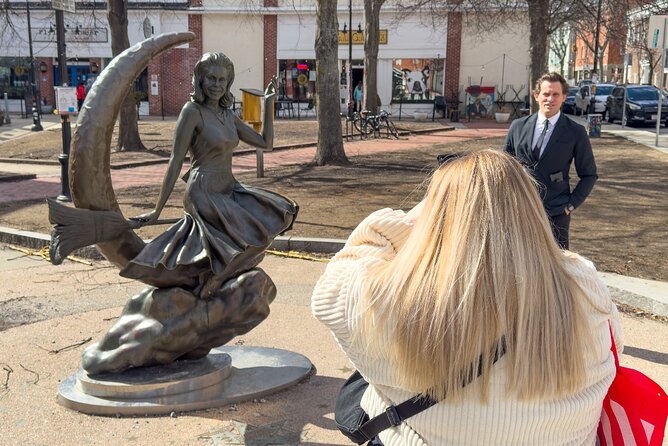
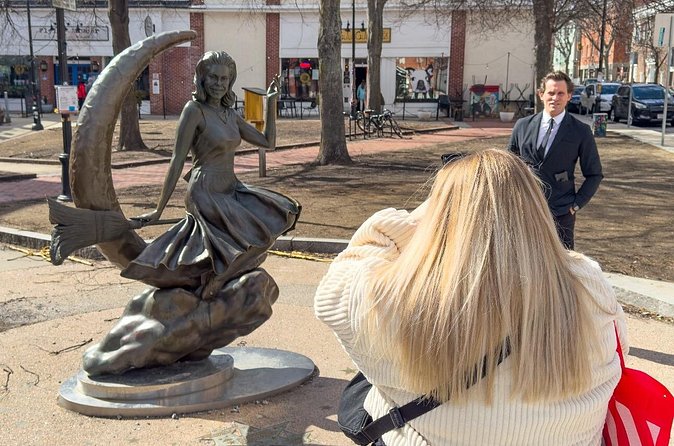
Stop 4: Bewitched Statue of Elizabeth Montgomery, pop culture with a memory

Then you meet the Bewitched statue of Elizabeth Montgomery. This stop is basically Salem’s pop culture overlay, where a famous TV connection turns into a doorway back to the real history.
This can be a fun breather without ruining the seriousness. The guide uses it to help you see how witch trial narratives have been repeated, repackaged, and turned into a tourism brand. You can stand next to something playful and still keep your learning grounded.
Expect about 10 minutes. The key is to use this moment to switch gears:
- Notice what people come to see because it is famous.
- Then let your guide bring it back to why Salem remains tied to the 1692 events.
If you like “spooky but with receipts,” this stop is where you get that balance.
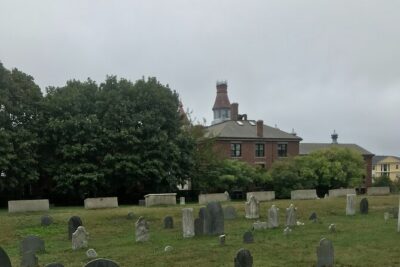
Stop 5: Howard Street Cemetery and the witch jail story of Giles Cory
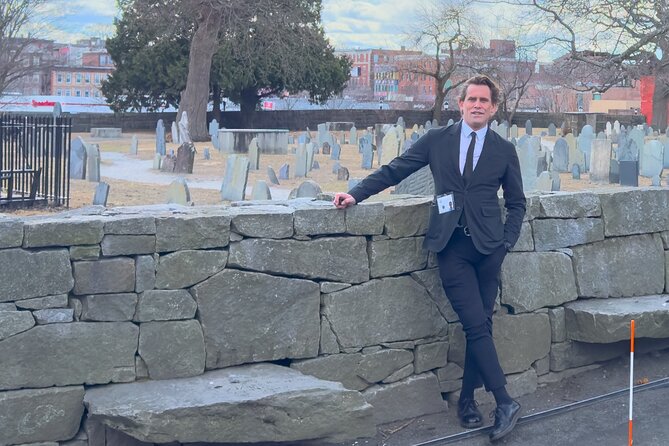
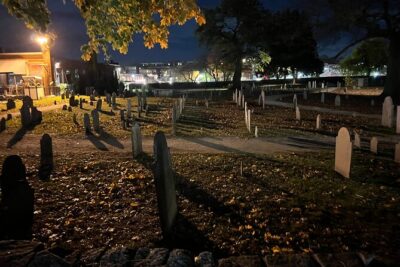
Your final stop is Howard Street Cemetery, including a look at the old witch jail and the story of Giles Cory and how he met his end.
This stop is longer, about 20 minutes, and that extra time makes sense. This is where the tour likely centers on the jail and individual fate, which are among the most difficult pieces of the Salem story.
What you should take from this stop:
- You are seeing the location connected to imprisonment, so the narrative feels physical.
- The guide ties the story of Giles Cory into the broader pattern of fear and accusation.
If you are trying to make sense of The Crucible or other Salem-related classroom stories, this is the stop that helps the names stop feeling abstract. A common praise in guest feedback is that the tour gives context, and Giles Cory’s story is a major part of making context stick.
Give yourself permission to slow down here. Even though it is a guided experience, a cemetery stop calls for a quieter brain.
The guide experience: empathy plus performance energy
One of the most praised parts of this tour is the guide style. Guests highlight empathy, a strong grasp of Salem’s historical context, and delivery that feels engaging rather than dry.
Jobian, a Salem native, is repeatedly mentioned by name. People also describe the presentation as fact-based rather than purely spooky entertainment. There are even mentions of theatrical flair, which can help you remember details without turning the subject into a comedy.
The practical upside for you is simple: when a guide can explain both the background and the human impact, you leave with a fuller understanding. You do not just know that witch trials happened. You understand the social pressure that made them possible and how Salem’s identity formed around them.
Also, several comments note Q and A and interaction. That is a big deal if you are traveling with someone curious but not into reading plaques alone.
What to expect from the walk itself
This is a walking tour with five stops and about 1 hour 15 total time. That pacing works well if:
- you want a structured overview of Salem without committing to a full half day,
- you prefer guided context over browsing alone,
- you like tours that end before your energy fully drains.
Because the stops are short, the guide has to prioritize. That is not a weakness. For most visitors, it is exactly what you want. You get a clear arc: memorial and meaning, civic setting, religious conflict, pop culture reflection, then the jail and individual story.
Just remember it is a walk through Salem streets, so wear comfortable shoes. One review calls out footwear because it is a walking format.
Who this Salem witch trials tour is best for
This tour is a strong match if you:
- want the real story behind Salem, with context, not just costumes,
- care about respectful treatment of tragic history,
- enjoy a guide who can mix clear explanations with engaging storytelling.
It is also a good fit for families. Reviews mention it works well for family groups and even for younger visitors who want history presented with energy.
You might want to skip this one if you are chasing only spooky thrills. The tone here is described as more history lesson than spooky party, so if that is your top goal, choose a more entertainment-heavy option instead.
Should you book? My decision rule
Book this tour if you want a compact, walkable Salem experience that connects the 1692 witch trials to real places, and you value a guide who handles the subject with care. At $29 for about 1 hour 15, with free admissions noted at each stop, it is a solid value for anyone who wants more than surface-level witch lore.
Skip it only if your priority is pure spooky entertainment or if you dislike walking tours in general. Otherwise, this is the kind of experience that helps Salem feel understandable, not just famous.
FAQ
How long is the Salem and The Witch Trials tour?
It lasts about 1 hour 15 minutes.
How much does it cost?
The price is $29.00 per person.
What language is the tour offered in?
The tour is offered in English.
Where does the tour start?
The tour starts at 158 Essex St, Salem, MA 01970, USA.
Is the tour ticket mobile?
Yes, it is a mobile ticket.
Are there admission fees at the stops?
The listed stops show admission ticket free.
Is there a limit on group size?
Yes, the maximum group size is 40 travelers.
Can I get a refund if I cancel?
Yes, there is free cancellation. You can cancel up to 24 hours in advance for a full refund.
Are service animals allowed?
Yes, service animals are allowed.
More Tour Reviews in Salem





Salem, Still More to See
More around Salem, freshly written up
- Private Walking Salem Legends Tour Professional Guide★ 5.0 · 3 reviews
- Pirates and Privateers Walking Tour with Real Pirates Admission★ 4.5 · 3 reviews
- Salem: Spanish-Speaking Witch Trials Walking Tour★ 5.0 · 3 reviews
- Cemetery and Witchcraft Trials Tour★ 5.0 · 4 reviews
- The Ghost Walk. Tortured Souls of Salem★ 5.0 · 4 reviews
- [ESP] History of Salem Witch Trials★ 4.0 · 5 reviews
Salem Witch Trials and History Tours, compared.
 ★ 5.0History and Hauntings of Salem Guided Walking TourFrom $3614,564 reviews
 ★ 4.5Salem’s Best Ghost TourFrom $304,186 reviews
 ★ 5.0Salem Voodoo, Vampires, and Ghosts Guided Walking Tour1,931 reviews
 ★ 5.0Bewitched Walking Tour of SalemFrom $351,895 reviews
 ★ 5.0Satanic Salem Walking TourFrom $301,635 reviews
 ★ 5.0Mysteries and Murders of Salem Guided Night-Time Walking TourFrom $361,488 reviews
 ★ 4.5The Salem Witch WalkFrom $251,301 reviews
 ★ 5.0Wicked Awesome Tours: Witch Trial History and Salem Haunts!From $291,032 reviews
Also filed under